Arctic seals are nearing extinction due to climate change, and more than half of the world’s bird species are in decline due to pressures from deforestation and agricultural expansion, according to the International Union for Conservation of Nature’s annual assessment.
The IUCN released its latest Red List of Threatened Species on Friday, saying one bright spot was the green sea turtle, which has made a significant recovery thanks to decades of conservation efforts.
At a time when many animals are at increased risk of disappearing forever, the updated list shows how dedicated efforts can bring species back from the brink, Rima Javad, vice chair of the IUCN Species Survival Commission, told The Associated Press.
“Hope and concern go hand in hand in this work,” Javad wrote in an email. “The same tenacity that brought green sea turtles back to life is reflected in small, everyday actions like championing sustainable choices, supporting conservation efforts, and inspiring leaders to deliver on their environmental commitments.”
This list is updated annually by a team of scientists who evaluate data on living things around the world. Andrew Farnsworth, a visiting researcher at the Cornell Lab of Ornithology who studies bird migration and was not involved in the IUCN report, said the scope of the study is vast and important for science.
Farnsworth said that while “each time a study is completed and revised, we learn more information and can answer more questions,” some species remain a mystery to researchers.
decrease in sea ice
All marine mammals in the Arctic, such as seals, whales and polar bears, depend on the habitat provided by sea ice, so anthropogenic climate change is reducing sea ice and putting them all at risk, said Kit Kovacs, co-chair of IUCN’s Species Survival Commission Pinniped Specialist Group, which focuses on seals.
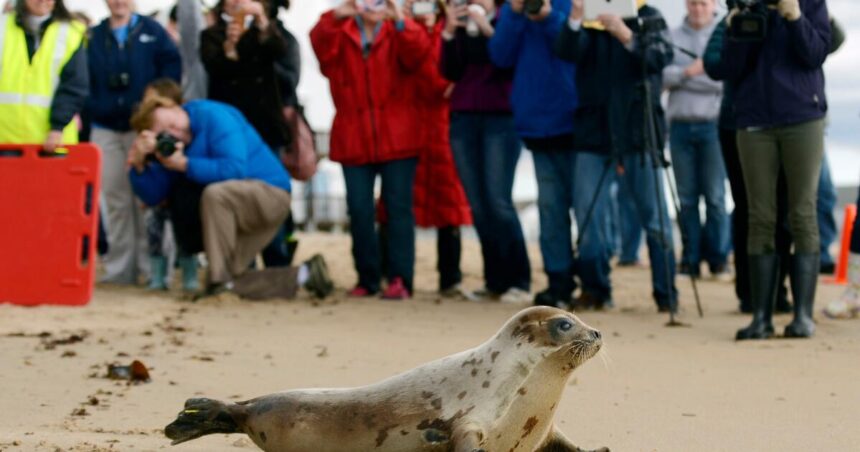
Three species featured in IUCN’s latest report – harp seals, hooded seals and bearded seals – have been upgraded to a status of more serious concern in the latest update, indicating they are increasingly at risk of extinction, Kovacs said.
Similar melting of glaciers and sea ice that destroys seal habitat “generally leads to an intensification of extreme weather events that are already impacting people around the world,” Kovacs wrote.
“When we act to help seals, we are acting to help humanity when it comes to climate change,” Kovacs said.
Global bird decline
The update also highlights Madagascar, West Africa, and Central America, where the Schlegel’s reed, black-crowned hornbill, and northern nightingale wren have all moved to near-threatened status. These are three birds that are in particular trouble, with about three-fifths of the world’s bird populations in decline.
Stuart Butchart, chief scientist at BirdLife International, said deforestation of tropical forests was part of a “disturbing array of threats” to birds, a list that included agricultural expansion and intensification, competition from invasive species and climate change.
“The fact that 61% of the world’s bird species are in decline is a wake-up call that cannot be ignored,” Butchart said.
The annual United Nations Climate Summit will be held in Belém, Brazil in November, and the Amazon and its value to humans and animals will be in the spotlight. But Cornell University’s Farnsworth said he is “less confident” that world leaders will take decisive action to protect endangered birds.
“I like to think that things like Birds are bipartisan and that we can find common ground,” he said. “But it’s not easy.”
green sea turtle
One success story is the recovery of green sea turtles in many parts of the world’s oceans. Experts see this as a bright spot, showing how effective human interventions such as legal protections and conservation programs can be.
Still, “it’s important to recognize that the benefits of sea turtle conservation efforts can take decades to be felt,” said Justin Perrault, vice president of research at the Loggerhead Marine Life Center in Juno Beach, Florida, who was not involved in the IUCN report.
Nicholas Pilcher, executive director of the Marine Research Foundation, said that while the overall success of green sea turtles should be celebrated and used as an example for other species, some species, such as hawksbill turtles and leatherback turtles, were not faring as well.
And even for green sea turtles, there remain areas where habitat is being compromised by other factors such as climate change and erosion, some of which are poorer and receive less conservation funding, Pilcher said.
But in areas where they have recovered, Pilcher said, this is “actually a great story that we can do something about this.” “We can do it. We can make a difference.”
Walling writes for The Associated Press.