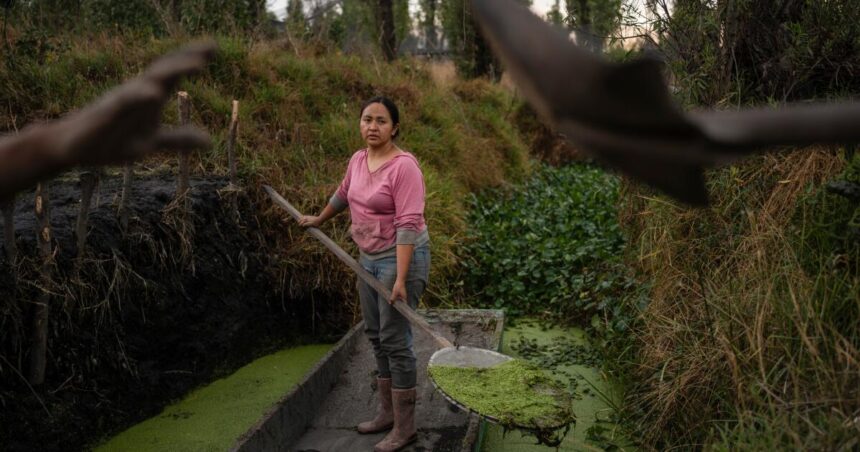
Jasmine Ordóñez watches the water from a wooden boat as she traverses the narrow channels connecting the labyrinth of chinampas, island farms built by the Aztecs thousands of years ago.
“Let’s close our eyes and ask Mother Water for permission to sail in peace,” she said as the boat moved slowly, in contrast to the heavy traffic in Mexico City just a few miles away.
Ordóñez owns one of the first farms on the island, built using mud from the bottom of the lake that once covered the area. When the boat arrives at her island, she proudly shows off the corn and leafy vegetables she grows. Her ancestors owned chinampas, but she needed to buy one because traditionally women did not inherit chinampas.
“My grandmother didn’t get any land. Back then, most of it was in the hands of men,” she said. By her side, Cassandra Garduño listens carefully. She did not inherit the Chinanpa family either.
Today, they are both part of a small but growing group of women who buy and sustainably grow chinampas to protect ecosystems increasingly threatened by urban development, mass tourism, and water pollution.
Expanding into a region still dominated by men was not easy. In the chinampas of Xochimilco and San Gregorio Atlapulco, very few women work on the land.
“People believe that only men have the physical ability to put themselves to work,” Garduño says. Mud stained the pale pink shirt she wore with her boots. She knows that her outfit gets some funny looks from the men who have been involved in chinnanpa for years, but instead of being upset, she finds it funny.
After years away, she returned to San Gregorio in 2021 to devote herself to chinampa farming. After attending college, she spent a long period of time working in conservation protecting manta rays and sharks in Ecuador. One day, she returned to San Gregorio and was shocked by the deterioration of her land, including declining canal levels, increasing pollution, and abandoned chinampas.
“That’s when I started realizing, ‘You’re part of this space, and part of your responsibility is to protect it,'” she said.
After saving money for a year, she bought a chinampa and was shocked to find it in such poor condition. A cleanup revealed pieces of an armchair, a television, and a beer bottle. She reopened canals that were clogged with trash and began planting crops. The distrust of the neighbors was clear.
“They said, ‘Look, this girl has never been here. Nobody knows her and she’s already doing what she wants to do,'” she recalled.
But she knew more than they thought. Garduño learned a lot as a young girl running around the chinampas, her grandfather’s flower “paradise.” She learned that the mud at the bottom of the canal is the best fertilizer because it contains mineral-rich ash from the volcanoes around Mexico City. She learned that planting a variety of crops prevents frost from ruining the entire crop, and that the flowers attract insects that make cabbage and kale inedible.
knowledge sharing
“Chinampas can have up to eight rotations per year, whereas other systems may have two or three rotations,” Garduño explained.
That’s why the Food and Agriculture Organization of the United Nations has recognized chinampas as one of the most productive farming systems on earth. Today, her fields are a melting pot of color, from the pale green of broccoli to the bright yellow of marigolds.
Since 2016, she has been working with the National Autonomous University of Mexico to advise other farmers who want to stop using pesticides and restore traditional practices that also help protect ecosystems. Garduño kneels next to the planting bed and suggests raising it so it doesn’t flood when it rains. Ordóñez takes note.
She bought the chinampa three years ago and is now aiming to earn the Echiketa Chinampara, a sustainability tag given by the university to farmers who use mud instead of chemicals as fertilizer. With this label, their products can command higher prices.
Diana Laura Vázquez Mendoza, from the university’s Institute of Biology, said 16 farmers have received the label so far, four of them women, adding that the project encourages women to “take back and produce chinampas.”
cleaning the canal
University-supported chinampas are equipped with filters made from aquatic plants to clean the water and prevent carp and tilapia from entering. Introduced to Xochimilco in the 1980s, these exotic species became predators of the ecosystem’s most prominent inhabitants, the Mexican salamander-like axolotl. Currently, this amphibian is at risk of extinction due to a combination of these invasive species and factors that pollute the canal. Sewage discharge from urban development, mass tourism, and pesticides in many chinampas.
“Chinapas are man-made agro-ecosystems created in pre-Hispanic times to feed the entire population, and it continues to this day,” Mendoza said. “So the way to protect Xochimilco is to also protect the chinampas.”
But walking through the area on a Sunday, it’s clear that the number of chinampas devoted to agriculture is dwindling. Hundreds of people come here every weekend to play soccer in chinampas converted into fields and drink in brightly painted boats known as trajineras. The impact of this change on wetlands is clear, with research by Luis Bohorquez Castro, a biologist at the Autonomous Capital University, finding pollutants in wetlands ranging from heavy metals such as iron, cadmium and lead to oils, detergents and pesticides.
Most of that comes from treatment plants in Xochimilco that discharge water and chinampas that use pesticides, according to Castro’s research.
preserve what is left of the past
“Look at the clarity of the water,” Ordonez said, reaching into the canal where he installed the biofilter. She knows that taking care of water is essential to maintaining this ecosystem. This wetland is the last remnant of the great Tenochtitlan, the capital of the Aztec empire built on a lake that once filled the Valley of Mexico. Today, only 3% of the original area of these lakes remains in Xochimilco, but they remain key to the city’s stability. If it disappeared, average temperatures in the capital could rise by up to 3.6 degrees Celsius, according to biologist Luis Zambrano.
Xochimilco and San Gregorio reduce flooding during the rainy season, provide natural carbon storage, and are home to hundreds of species, including herons and Tlaloc frogs. “Look at the red-headed birds in the lagoon!” Garduño exclaimed as he drove home on a dirt road at dusk after a long day in the chinampas.
For her, this is still the paradise where she roamed with her grandfather. She is convinced that women are needed to preserve chinampas, and hopes that within 10 years more people will own and care for chinampas.
“The joint labor of women and men allows us to do what we all want: to preserve what we have left for as long as possible,” she said.
De Miguel writes for The Associated Press. This article is a collaboration between AP and Mongabay.