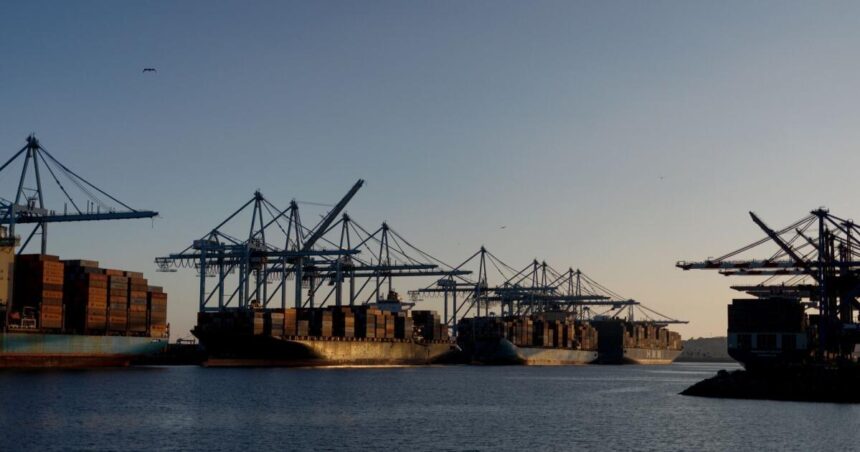
Global shipping regulators are giving the green light to a global tax on the industry’s emissions, prompting the Trump administration to threaten retaliatory tariffs.
The International Maritime Organization is expected to decide this week on sweeping new rules that will make the maritime sector pay for the more than 1 billion tonnes of greenhouse gases it emits each year. In April, the draft plan received wide support, with the United States calling it a “global carbon tax” on citizens and saying it would consider measures such as tariffs and port taxes.
The IMO plan has been years in the making, and its adoption would be a victory for multilateral climate regulation in the face of tariff threats and widespread damage to environmental progress ahead of next month’s COP30 climate change summit in Brazil. As for shipping, it would pave the way for the elimination of oil as a primary fuel, benefiting cleaner options such as ammonia, but could initially raise more than $10 billion a year, with costs that could ripple throughout the supply chain.
Although final adoption is not guaranteed due to opposition from the U.S. government, industry participants expect it to pass. If there is no consensus, a two-thirds vote is required for passage.
Representatives of the International Chamber of Shipping (which covers more than 80% of the world’s merchant fleet and therefore a huge portion of global trade) expect the levy to pass. Edmund Hughes, a former IMO official who worked in environmental regulation, agrees. Boston Consulting Group will study the results of the April vote and which countries will benefit from the plan, and also expects regulations to be adopted.
“This is a defining moment for the industry and a pivotal step in the global decarbonization effort,” said BCG Partner Peter Jameson. “Some political parties may try to slow down or complicate the process through political pressure, but this will not be enough to change the outcome.”
America takes a rebellious attitude
The United States has harshly criticized the plan for an “unaccountable UN agency” and is sending a delegation to a meeting in London this week. Last week, the U.S. government again urged other governments to reject the restrictions, saying they could have a “disastrous” economic impact, with some estimates suggesting shipping costs would jump by more than 10%.
On Friday, the State Department said it was considering options including tariffs. The same day, the country issued a separate statement saying that measures it was considering against countries that support the rule include visa restrictions, sanctions on officials and commercial fines, but did not mention tariffs.
In response to additional questions this week, Bloomberg would not confirm or deny whether tariffs remained on the table as part of the options being considered.
The regulation will raise costs for everyone and risks “becoming a global environmental slush fund at the expense of the shipping industry and its customers,” a US representative said Tuesday in a speech at a conference scheduled to be held this week.
Several countries, including the UK and the Netherlands, expressed support for the framework at the meeting.
The tariffs would be a further concern for global trade, in addition to President Trump’s so-called reciprocal tariffs ranging from 10% to 50% on imports from major trading partners. He has also given mandates to sectors deemed critical to national security, such as automobiles, steel and aluminum, and plans to give mandates to other sectors such as semiconductors, pharmaceuticals and industrial machinery.
Rhetoric between China and the United States has intensified in recent days, with both countries threatening to further tighten trade barriers if the other side does not reduce some of them.
“It would be foolish to underestimate the power of the United States,” said Feig Abbasov, director of shipping at the non-governmental organization Transport and Environment.
The adoption of the IMO plan would be a rare bright spot in recent international climate diplomacy and regulation. The Trump administration is dismantling domestic climate policy and disrupting global emissions reduction efforts. And companies have abandoned climate action over the past year as the realities of meeting ambitious deadlines became clear and the marketing benefits of having green credentials waned.
new rules mean penalties
The planned rules would force ships over 5,000 gross tonnage to curb their emissions along two lines: a “basic” target and a more stringent “direct compliance” target.
If a vessel meets the basic target but does not meet the more stringent targets, it will effectively be charged $100 per ton for the missed targets. Failure to meet even the baseline targets will result in a $100 per tonne charge for the difference between the two benchmarks, plus an even more severe penalty of $380 per tonne.
The money will go into a fund that will distribute the proceeds in a variety of ways, including rewarding ships that use low-emission fuels. The regulation is scheduled to take effect in 2027, but payments do not have to start until 2029.
The industry accounts for more than four-fifths of global trade and more than 1% of all emissions, and the IMO wants to reduce international shipping to virtually zero by mid-century. This push will require major changes to the fuel supply chain, requiring shippers to use cleaner fuels that are more expensive than traditional oil or pay fees if they miss targets.
Sora Jen, a senior researcher at the International Clean Transport Council, said the IMO framework is the world’s first global fixed emissions tax for all industries. A similar mechanism exists for airlines, which will become mandatory from 2027, and involves airlines purchasing offsets with no fixed costs.
enforcement issues
One question is how the charges will be enforced if a country withdraws from a major treaty governing air pollution from ships.
Torre Lomba, director of decarbonization at classification society DNV, said that even if a flag state (the country where a ship is registered) does not enforce regulations, ships flying that flag are subject to port state regulations in countries that comply with the rules. In theory, such ships can only sail domestically unless they voluntarily comply with the regulations.
“This is a big deal,” said Hughes, a former IMO official and director of Green Marine Associates. “It’s taken a lot of effort to get to this point. I don’t think the position will change much.”
Wittels writes for Bloomberg.