California is suing three plastic bag manufacturers that officials say are violating state law by advertising and offering bags that are recyclable when they are not, according to Atty. Gen. Rob Bonta made the announcement Friday.
The attorneys general’s office said the companies named in the lawsuit, Novolex Holdings LLC (one of the world’s largest food, beverage and specialty packaging companies), Interplast Group Corporation and Mettler Packaging LLC, failed to provide evidence that the plastic bags they sold to California stores were recycled.
At Friday’s press conference, Bonta also announced settlements with four plastic bag manufacturers (Revolution, Metropoli, Pre-Zero and API) who agreed to stop selling plastic bags in the state and pay a total of more than $1.7 million for selling non-recyclable plastic bags. The settlement includes $1.1 million in civil penalties and more than $636,000 in attorney fees.
“Plastic bag companies continue to distribute non-recyclable plastic bags in California and mislead Californians about the bags’ recyclability,” Bonta said. “In fact, even if consumers disposed of these plastic bags properly, they were overwhelmingly not recycled and could not be recycled in California. The problem is that producers have known or should have known this fact for years.”
The result, Bonta said, is that billions of plastic takeout bags end up in landfills, incinerators and the environment.
All plastic bags sold to consumers at retail stores in California are not recyclable and should no longer be distributed. As plastic bags are phased out, stores will need to switch to paper bags and reusable canvas bags, Bonta said.
The lawsuit asks the court to not only enforce the state’s consumer protection law and the state’s single-use plastic bag ban, SB 270, but also force the companies to repay the profits they made from selling the bags and any additional penalties.
Novolex Holdings LLC, Interplast Group Corp. and Mettler Packaging LLC did not immediately respond to emails seeking comment.
Friday’s press conference comes on the heels of a years-long national investigation into the fossil fuel and petrochemical industries, accusing them of creating and exacerbating the global plastic waste pollution crisis and deceiving the public that recycling could solve the plastic waste problem.
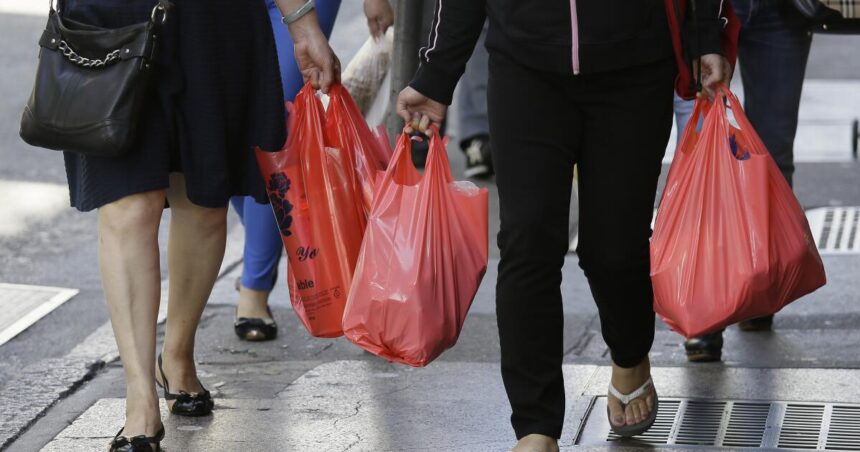
Since California adopted the nation’s first single-use plastic shopping bag ban in 2014, most retailers have begun offering customers thick, reusable plastic bags that are supposed to be recyclable.
Both of these materials are recyclable, but experts say they are not commonly used in residential or consumer environments.
In 2022, companies that manufacture plastic bags introduced a requirement for plastic bags sold in California to substantiate claims that the entire product and facilities within the state are recyclable.
He said researchers found that these thick, reusable plastic bags are not accepted at most recycling facilities.
Although the bags display a “chasing arrow” recycling symbol to instruct consumers to recycle them, only two of the 69 recycling facilities surveyed as part of the state study said they accepted plastic bags. And according to the Attorney General’s Office, those facilities could not confirm whether the bags were ultimately recycled.
According to the Department of Energy, the United States generates approximately 48 million tons of plastic waste each year, and only 5 to 6 percent is recycled, with the rest incinerated or sent to landfills.
“We have to think about the cost to the environment, to our future, to our climate, to our planet, of the non-recyclable plastic bags that strangle us in our waterways, oceans and streams,” Bonta said. “That costs a lot of money.”
Times staff writer Suzanne Last contributed to this report