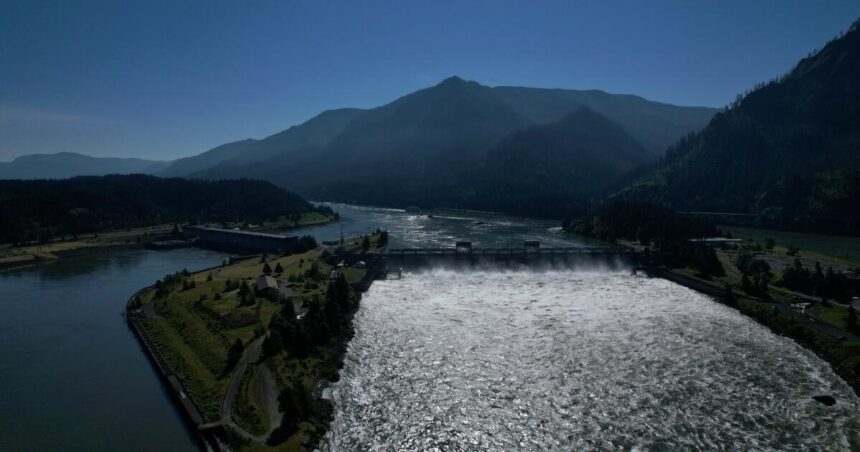
Conservationists and the state of Oregon have asked a federal court to approve changes to dam operations on the Snake and lower Columbia Rivers aimed at restoring salmon populations. This is the latest move in a recently resumed lawsuit over the impact of federally operated dams on fish.
The main requests include lowering the water level in the reservoir so that fish can pass through the reservoir faster, and increasing the outflow so that young fish can pass through the dam without going through the turbines.
The request, which covers eight dams, was part of a motion for a preliminary injunction filed Tuesday in U.S. District Court by plaintiffs who include environmental groups such as the National Wildlife Federation. Defendants include federal agencies such as the National Marine Fisheries Service and the U.S. Army Corps of Engineers.
Emails seeking comment from a federal fisheries spokesperson and several attorneys listed in court records for federal defendants received automated responses saying they were furloughed due to the government shutdown.
The decades-old legal battle was revived last month after President Trump withdrew the United States from the Resilient Columbia Basin Agreement in June. A deal signed in late 2023 with Washington, Oregon and four Native American tribes, a $1 billion plan to help restore decimated salmon populations in the Pacific Northwest, granted a moratorium on litigation.
The agreement was hailed as historic by the Biden administration, tribes and conservationists, but the current administration views it as “radical environmentalism” that could lead to the failure of the four Snake River dams.
Following the federal government’s withdrawal from the agreement, “going back to court is the best way to prevent the depletion of imperiled fish populations,” Mike Leahy, senior director of wildlife, hunting and fisheries policy at the National Wildlife Federation, said in a statement.
The Columbia River Basin spans an area roughly the size of Texas and was once the world’s largest salmon-producing river system, home to at least 16 species of salmon and steelhead. Currently, four species are extinct and seven are listed under the Endangered Species Act. The killer whale population, another iconic but endangered species in the Northwest, also depends on salmon.
The first dams were built on the Columbia River in the 1930s, including Grand Coulee Dam and Bonneville Dam, providing jobs as well as hydropower and navigation during the Great Depression. They make the town of Lewiston, Idaho, the most inland port on the West Coast, and many farmers in the region rely on barges to ship their crops.
Opponents of the proposed dam changes include the Inland Port Navigation Group, which said in a statement that increased spills “could have a disproportionately negative impact on navigation, resulting in disruption to the flow of commerce and a highly disruptive impact on local communities and economies.”
However, dams are also seen as a major cause of salmon decline, and local tribes consider salmon to be part of their cultural and spiritual identity.
“They are the backbone of entire ecosystems. They are an important economic and cultural resource for entire regions and are central to the way of life for so many Native American tribes,” said Amanda Goodin, senior attorney at the nonprofit Earthjustice, which represents conservation, clean energy and fishing groups in the case.
“I think losing them means losing a part of us as people in the North West,” Goodin added.
The dams being changed are Ice Harbor, Lower Monumental, Little Goose, Lower Granite, Bonneville, The Dalles, John Day, and McNally.
Rush writes for The Associated Press.