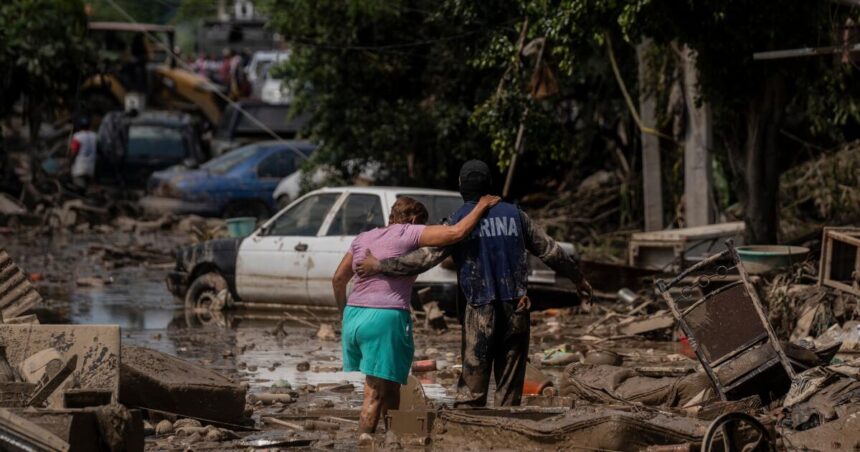
Recent heavy rains in central-eastern Mexico have left at least 76 people dead and dozens more missing, again raising questions about the government’s ability to warn people of severe weather in a timely manner.
Authorities continue to describe days of heavy rain this month that caused landslides and river flooding as unpredictable. Residents say they have never seen anything like it. But researchers say climate change has accelerated these events and made them more frequent, so what was once considered normal no longer applies. And that requires preparation.
“We are increasingly affected by these phenomena,” said Cristian Dominguez, a researcher at the National Autonomous University of Mexico’s Institute of Atmospheric and Climate Change. “We don’t know what to do, we fail because we didn’t receive adequate warning, and we can’t continue like this.” She recalled that last year’s crisis was related to drought, but this year it rained.
This is a concern not only for Mexico but also for countries with more resources and advanced technology, such as the United States, where devastating flash floods in Texas this year killed at least 136 people. Experts say society and governments seem stuck in the past and have not accepted that severe weather is now the norm.
In the case of Mexico, last year’s president, Claudia Sheinbaum, is a trained scientist with a background in climate change. But while he signaled a willingness last week to review precautionary procedures, he made no mention of climate change and argued that it is impossible to predict exactly how much rain will fall in some areas.
Carlos Valdes, former director of Mexico’s National Disaster Prevention Center, said “we need to consider the language used” in how to communicate the danger of an event. “The first thing we have to do is recognize that there is change. … The atypical is now the most typical.”
Technology gaps and prevention
There is a technological gap. For example, Dominguez recognized that Mexico doesn’t have all the equipment to provide detailed hydrological forecasts, such as real-time river level measurements or enough weather radar to help meteorologists make better predictions.
But she stressed that even existing forecasts could allow for far better prevention strategies if authorities considered not only hurricane preparedness, but also the potential for dangerous conditions to arise from the confluence of different weather systems, as was the case with the recent floods.
Heavy rain was expected to dump nearly 8 inches of rain in the Gulf Coast state of Veracruz, a day before major rivers in the northern part of the state crested their banks.
Although it ultimately tripled, Dominguez said the initial forecast should have been enough for residents and authorities to organize.
But in Poza Rica, the worst-hit city, residents began evacuating their homes after water had already begun to flood. Some said authorities warned too late. Most people had no idea it would be this bad.
AccuWeather Chief Meteorologist Jonathan Porter said climate change is causing severe weather to occur outside of expected seasons and in places not normally associated with flood risk.
“When the elements align, severe weather can occur anywhere,” he says.
training and education
Mexico has risk maps and civil defense officials are in charge of warning the public, “but in addition to warnings, the public also needs to understand what is being said,” Dominguez said.
In late 2023, just after Hurricane Otis devastated Acapulco, it became incredibly powerful within hours. A woman who lives in the affected neighborhood said she had heard that a Category 5 hurricane was coming, but she didn’t know it would blow away all the houses.
Experts say not only civil defense personnel need training, but people also need to be educated.
For decades, Mexico has developed new ways to warn of seismic activity in south-central Mexico. With Ortiz’s memory still fresh, Sheinbaum said the administration will put more emphasis on hurricane and rain prevention.
On October 10, thousands of soldiers and authorities worked in Veracruz state to reopen roads cut off by landslides and washed away bridges. But in the neighboring state of Tamaulipas just to the north, officials monitoring the Panuco River had already issued a clearer warning of possible flooding the previous day when water levels rose nearly a foot.
Sheinbaum said on October 10 that the region’s mayors were informed in time and nearly 500 people had already been moved to evacuation centers. The river continued to rise the next day.
“If the authorities act properly, nothing will happen,” Valdez said.
Verza writes for The Associated Press.