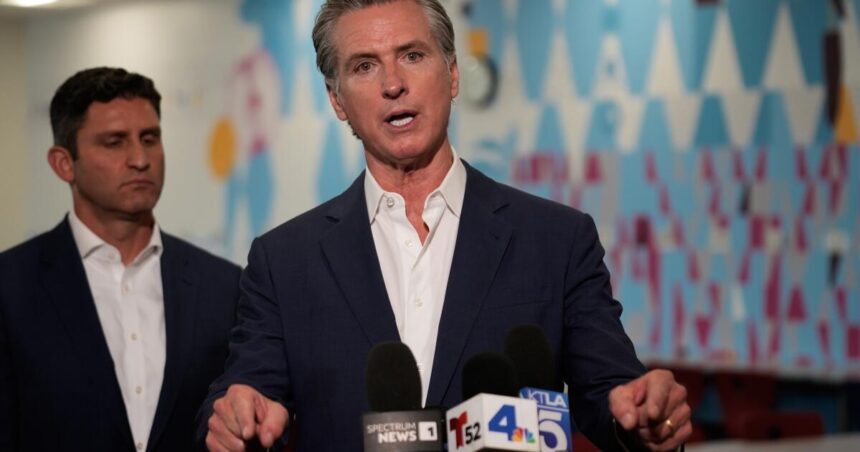
Gov. Gavin Newsom announced Monday that food assistance benefits for millions of low-income Californians could be delayed starting Nov. 1 if the ongoing federal government shutdown does not end by Thursday.
The benefits are issued under the Supplemental Nutrition Assistance Program (SNAP), formerly known as food stamps, and also include federally funded benefits on CalFresh cards. They support approximately 5.5 million Californians.
Newsom blamed President Trump for the potential disruption to SNAP, and the broader shutdown, with the potential suspension coming just in time for the Thanksgiving holiday.
“President Trump’s failure to open the federal government has put lives at risk and driven up the price of food and other basic necessities just as the holiday season approaches,” Newsom said. “It is long past time for Republicans in Congress to stand up, stand up to Trump, and serve the American people.”
As in previous years, the White House responded by blaming Democrats for the government shutdown.
“Democrats’ decision to shut down the government is hurting Americans across the country,” White House press secretary Abigail Jackson said.Democrats “can always choose to reopen the government” by voting in favor of a continuing resolution to fund the government as budget negotiations continue, a move she repeated during the Biden administration.
“Newsom should urge his fellow Democrats to stop hurting the American people,” Jackson said, using President Trump’s favorite insult against Newsom. “The Trump administration is working day and night to alleviate the pain that Democrats are causing, but even that is unsettling the left, with many Democrats criticizing the president’s efforts to fund payments to soldiers and food assistance to women and children.”
Congressional Republicans also blame Democrats for the government shutdown and the resulting disruption to federal programs. Democrats are refusing to vote on the Republican-backed funding measure, based largely on the party’s decision to eliminate subsidies for the health care system that millions of Americans rely on.
Newsom’s warnings about SNAP benefits followed on both sides of the political spectrum after the U.S. Department of Agriculture warned state agencies in an Oct. 10 letter that funding for benefits could be disrupted due to the government shutdown.
States must take steps to issue November benefits by the end of the month, so the shutdown would need to end sooner than Nov. 1 for the benefits to be distributed in time.
Newsom’s office said Californians could see their benefits suspended or delayed if the shutdown doesn’t end by Thursday. SNAP benefits for November “will not be paid if the federal government shutdown continues beyond October 27.”
Newsom’s office said the defunding would affect not only federal funding but also other state-funded benefits. More than 63% of California’s SNAP recipients are children or seniors, according to Newsom’s office.
“Government should be judged on how it protects people’s lives, health, and well-being. Parents and caregivers should not have to choose between buying groceries and paying their bills,” California First Partner Jennifer Siebel Newsom said in a statement.
States were already preparing for other changes to SNAP eligibility under the Republican-passed Big Beautiful Act, which would place new limits on SNAP benefits, including for non-working adults. Republicans argue these restrictions will encourage more able-bodied adults to return to work to support their families.
Many Democratic lawmakers and advocacy groups working to protect low-income families and children have argued that limiting SNAP benefits would disproportionately impact some of the nation’s most vulnerable populations, including poor children.
According to the USDA, approximately 41.7 million Americans will be served with SNAP benefits each month in fiscal year 2024, at a cost of nearly $100 billion annually. The USDA has some emergency funds available to continue benefits in the short term, but advocates said it’s not enough to cover all monthly benefits.
Andrew Cheyne, managing director of public policy for the advocacy group End Child Poverty California, urged the USDA to tap into the emergency fund and other available sources to prevent SNAP benefits from being interrupted, saying that would have “dire consequences.”
“CalFresh is a lifeline for 5.5 million Californians who rely on the program to feed themselves, including 2 million children. It is unconscionable that in just a few days these children and families will be left without knowing where their next meal will come from,” Chain said.
He said the science is clear that “even short-term food insecurity has long-term effects on children’s growth and development.”
Children Now president Ted Lempert said any disruption would be “horrifying.”
“We represent the needs of children and families, and children need food, the basic support to live, function and go to school,” he said. “So this could be really devastating.”
Times staff writer Jenny Gold contributed to this report.