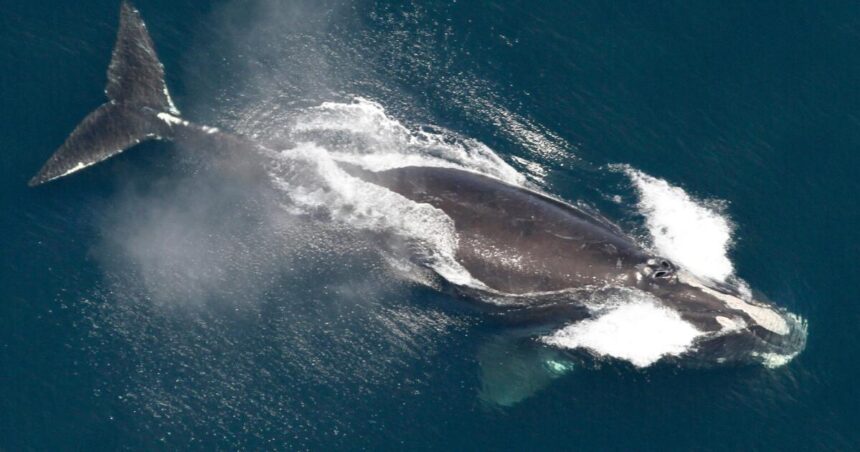
One of the rarest whales on Earth continues its encouraging growth trend following new efforts to protect the giant animals, scientists who study them have announced.
The North Atlantic right whale population is now estimated at 384 individuals, an increase of eight individuals from the previous year, according to a report from the North Atlantic Right Whale Association released Tuesday. Whales have shown a slow population growth trend over the past four years, increasing by more than 7% of their population in 2020, the consortium said.
This is a welcome development after an alarming decline over the past decade. The whale population, which is vulnerable to collisions with ships and entanglement in fishing gear, declined by about 25% from 2010 to 2020.
Philip Hamilton, senior scientist at the New England Aquarium’s Anderson Cabot Marine Life Center, said the whales’ recovery trend is evidence of the importance of conservation measures. The center and the National Oceanic and Atmospheric Administration work together to calculate population estimates.
With the increasing presence of whales in the Gulf of St. Lawrence, Canada’s new management measures to keep them safe are especially important, Hamilton said.
“We know that a modest increase each year, if sustained, will lead to population growth,” Hamilton said. “It’s just a matter of whether we can maintain it.”
Scientists have warned in recent years that the whales’ recovery has been slow and stronger protection measures are needed, while the giant whales continue to face the threat of accidental death. But Hamilton says there is also reason to believe that whales are turning a corner in terms of their low reproduction numbers.
Scientists say whales are less likely to breed if they are injured or lack food. This poses a problem because whales are not producing enough babies to sustain their populations.
But this year, four mother whales gave birth to their calves for the first time, Hamilton said. And some other established mother whales had shorter intervals between calves, he said.
In total, 11 calves were born, which is fewer than the researchers had hoped, but the addition of new females to the reproductive pool is encouraging, Hamilton said.
Heather Pettis, who leads the right whale research program at the Cabot Center and is president of the North Atlantic Right Whale Consortium, said any number of calves is helpful in a year with zero deaths.
“The modest increase in population estimates, combined with fewer detected deaths and fewer injuries than in past years, gives us cautious optimism about the future of the North Atlantic right whale,” Pettis said. “What we’ve seen so far is that this population could benefit from every penny.”
Whales were hunted to the brink of extinction during the era of commercial whaling. They have been protected by the federal government for decades.
Whales migrate each year from their calving grounds off the coast of Florida and Georgia to feeding grounds off the coast of New England and Canada. Some scientists say warming oceans have made the journey more dangerous as whales have had to deviate from established protected areas in search of food.
Environmental groups warned Tuesday that the whales remain endangered and require more aggressive protection to fully recover.
“Continued attacks on the Marine Mammal Protection Act and efforts to undermine NOAA’s science-based protection measures are putting this vulnerable population at even greater risk,” said Gib Brogan, Oceana’s senior campaign director. “We need Congress to support, not undermine, the laws, programs, and experts that give North Atlantic right whales a fighting chance for continued survival.”
Whittle writes for The Associated Press.