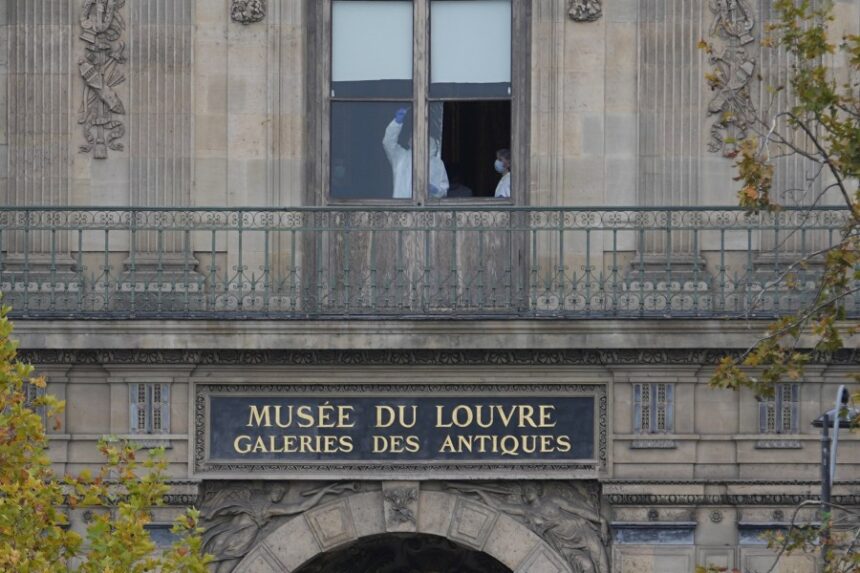
PARIS (AP) – The glittering sapphires, emeralds and diamonds that once adorned the French royal family may be lost forever, experts said Tuesday, after a brazen four-minute robbery in broad daylight stunned the nation and left the government struggling to explain a new debacle at the Louvre.
The stolen items – an emerald necklace and earrings, two crowns, two brooches, and a sapphire necklace and earrings – represented the pinnacle of 19th century haute jewelery. But for the royal family, they were more than just decoration. These works were political statements about French wealth, power, and cultural imports. And they are so important that they were among the treasures saved from the government’s 1887 auction of most of the royal jewels.
Paris prosecutor Laure Becuau, who is leading the investigation, said on Tuesday that the stolen jewelery was worth an estimated $102 million (88 million euros) in monetary terms, but also noted that this estimate did not include historical value. He said about 100 investigators are currently working on the police search for suspects and jewelry.
The theft of the Crown Jewels has once again left the French government scrambling to explain the recent embarrassing situation at the Louvre, which is plagued by overcrowding and dilapidated facilities. In 2024, activists threw cans of soup at the Mona Lisa. And in June, the museum was forced to shut down due to a strike by staff disgruntled by mass tourism. President Emmanuel Macron has announced that the Mona Lisa, which was stolen in 1911 by a former museum employee and recovered two years later, will undergo extensive renovations and be given its own room.
Experts say the glittering jewels, artifacts of ancient French culture, are likely being secretly dismantled and hastily sold as individual pieces that may or may not be identified as part of France’s crown jewels.
“It is extremely unlikely that these gemstones will ever be recovered and seen again,” Tobias Cormind, managing director of 77 Diamonds, a leading European diamond jeweler, said in a statement. “If these gems were crushed and sold, they would effectively disappear from history and be lost to the world forever.”
The crown jewels are a symbol of heritage and national pride
At once intimate and public, the Crown Jewels are kept safe from the Tower of London to the Imperial Palace in Tokyo as a visual symbol of national identity.
In the Louvre’s case, the jewels were stolen from the former palace’s gilded Apollo Museum, which itself is a work of art made of “suns, gold and diamonds,” according to the museum’s website. Interior Minister Laurent Nuñez said more than 60 police investigators were involved in the search for the four robbery suspects. Nuñez said the thieves split into two groups, and the two men got into a truck with a cherry picker, which they used to climb up to the gallery. Photos showed equipment ladders extending to floors above street level.
Officials said the item was part of a collection whose origins as a crown jewel date back to the 16th century, when Pope Francis I declared it a state. The Paris public prosecutor’s office, which led the investigation, announced that two men wearing bright yellow jackets entered the gallery at 9:34 a.m. (30 minutes after the opening time), left the room at 9:38 a.m. and fled on two motorcycles.
The missing parts include two crowns, or diadems. One, given by Emperor Napoleon III to Empress Eugenie to celebrate her marriage in 1853, contains more than 200 pearls and nearly 2,000 diamonds. The second was a starry sapphire and diamond headpiece, necklace and one earring worn by Queen Marie-Amélie, among others, French authorities said.
Also stolen in 1810 was a necklace consisting of dozens of emeralds and more than 1,000 diamonds that was a wedding present from Napoleon Bonaparte to his second wife, Marie Louise of Austria. Her matching earrings were also stolen. French officials said the thieves also took away a brooch from the reliquary and a large bodice ribbon worn by Empress Eugenie, both of which were encrusted with diamonds.
The robbers dropped or abandoned the ninth major item, a crown adorned with a golden eagle, 1,354 diamonds and 56 emeralds, worn by Empress Eugenie.
Other items in the Crown Jewels collection remained untouched, and the Louvre said it contained 23 jewels before the robbery. For example, what remains is the plum-sized Regent, said to be the largest diamond of its kind in Europe.
Now it’s a race against time
Beyond the monetary value of stolen jewelry, the emotional loss is keenly felt and easy to measure. Many say France’s failure to secure its most precious supplies was a stain on national pride.
“These are souvenirs taken from French people for their families,” conservative lawmaker Maxime Michelet said in parliament on Tuesday, questioning the government about the security of the Louvre and other cultural institutions.
“Empress Eugenie’s crown, stolen and then dropped and found broken in a gutter, became a symbol of the decline of this once admired country,” Michelet said. “This is a shame for our country, which cannot guarantee the safety of the world’s largest museum.”
Sunday’s theft was not the first Louvre robbery in recent years. But this incident stood out as one of the most high-profile museum thefts in living memory for its foresight, speed, and almost cinematic quality. In fact, this mirrors the fictional theft of the crown from the Louvre by a “gentleman thief” in the French TV show “Lupin,” which is based on a series of stories from 1905.
According to one theft investigator, most of the romance in these theft cases is a creation of the entertainment world. Christopher A. Marinello, an attorney with Art Recovery International, said he has never seen “order theft” by clandestine collectors.
“These criminals are just trying to steal whatever they can,” Marinello said. “They chose this room because it was close to the window. They chose the jewels because they thought they could take them apart, take out the settings, and take the diamonds, sapphires and emeralds overseas. “No one would ever know what they did to the dodgy dealers who tried to recut the jewels.”
It’s now a race against time, both for the French authorities hunting down the thieves, and for the perpetrators themselves as they struggle to find buyers for their royal treasures.
Dutch art detective Arthur Brand said: “Nobody will touch these objects. They’re too famous. They’re too hot. If they get caught, they’ll go to jail.” “I can’t sell it, and I can’t leave it to my children.”
___
Kelman reported from London. Associated Press writer Mike Corder contributed from The Hague, Netherlands.