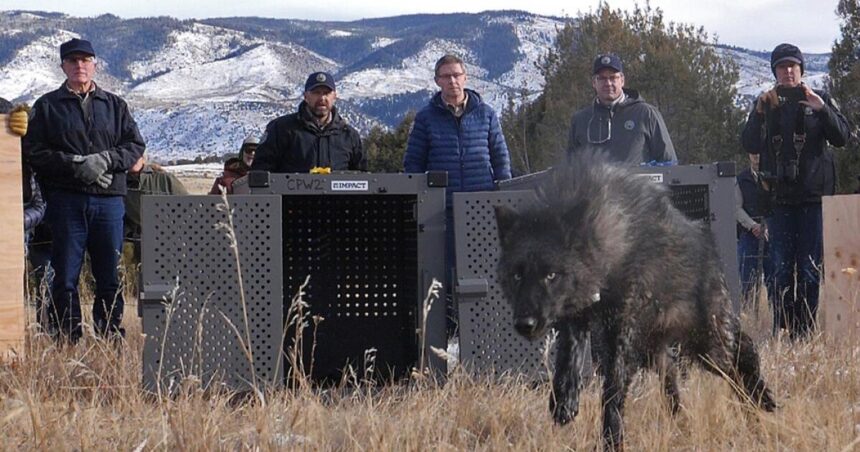
The Trump administration has directed Colorado to halt imports of gray wolves from Canada as part of the state’s efforts to restore the predator, a change that could hamper further reintroduction plans this winter.
Colorado voters narrowly approved wolf reintroduction in 2020, and the state will release wolves west of the Continental Divide starting in 2023. Approximately 30 wolves currently roam the state’s mountains, and the state’s management plan predicts there could be more than 200 wolves in the long term.
The program was unpopular in rural areas where some wolves attacked livestock. After two winters of releases under the Biden administration, wolf opponents now appear to have support from federal officials under President Trump.
Colorado wolves must come from the Northern Rockies, U.S. Fish and Wildlife Service Director Brian Nesvik told Colorado Parks and Wildlife Service Director Jeff Davis in a recent letter.
Nesvik said Colorado must “immediately cease and desist all efforts related to the capture, transportation and/or release of unavailable gray wolves” from the northern Rocky Mountain state.
Most of those states, including Idaho, Montana and Wyoming in the Yellowstone region, where wolves were reintroduced from Canada in the 1990s, have said they do not want to participate in Colorado’s reintroduction.
If that happens, Colorado could be in trouble this winter. Colorado Parks and Wildlife spokesperson Luke Perkins said in a statement that the state plans to relocate 10 to 15 wolves under an agreement with British Columbia’s Ministry of Water, Land and Resources Management.
Perkins said the agreement was signed before the state received the Oct. 10 letter from Nesvik. He said the state “continues to consider all options to support this year’s gray wolf release” after receiving “updated guidance” from the Fish and Wildlife Service.
Some of the wolves reintroduced to Colorado came from Oregon, while recently released wolves came from British Columbia.
The current issue is whether the federal agency, when designating an “experimental” population of reintroduced wolves in Colorado, required that the wolves come only from the Rocky Mountain states of the northern United States.
A 2023 federal notification said the northern Rocky Mountain region is only a “preferred” source for wolves, not a required source.
Lisa Saltzberg, an attorney for the wildlife advocacy group, said in a statement that the Fish and Wildlife Service is using “distorted language” when it says wolves cannot come from Canada or Alaska.
Coloradans “should be proud of our state’s leadership in conservation and coexistence, and the wolf reintroduction program exemplifies those values,” Saltzberg said.
The Colorado Governor’s Office and the Colorado Parks and Wildlife Department have been in contact with the U.S. Department of the Interior about the letter and are considering “all options” to allow wolves to be released this year, Shelby Wieman, a spokeswoman for Gov. Jared Polis, said in an email.
Garrett Peterson, a spokesman for the Fish and Wildlife Service, said in a voicemail that he won’t be taking calls until the government shutdown ends, but he didn’t immediately return a message seeking comment.
Gruber writes for The Associated Press.