Michaela Thompson, an unemployed mother in the San Fernando Valley, relies on federal aid for the specialized formula her 15-month-old daughter needs because of an incurable illness. It’s $47 for a 5-day supply, which is otherwise out of reach for her.
But with federal Supplemental Nutrition Assistance Program benefits (formerly known as food stamps) suspended, Thompson said she doesn’t know how she’ll fill her daughter’s baby bottles.
“It feels like the world is falling apart right now,” she said. “I’m worried about my family and my daughter.”
Millions of low-income families in California and across the country who rely on SNAP benefits to put food on the table – about 1 in 8 Americans – are facing similar fears this week. Federal and state officials have warned that no money will be released for November without a resolution to address the ongoing federal shutdown, and Congress shows no signs of relenting.
Governor Gavin Newsom and Governor Atty. Gen. Rob Bonta announced Tuesday that California is joining other Democratic-led states in suing the Trump administration to use reserve funds to force SNAP payments, but even if the lawsuit is successful, it won’t prevent all the chaos.
Some of California’s 5.5 million residents, including 2 million children, are counting on those benefits to buy groceries in time after Friday, but state officials say it’s already too late, as many will have already used up their October benefits. Advocates warn that demand will be overwhelmed as household pantries and CalFresh cards empty, arguing that this is no longer a risk but a certainty.
“We’re past the point where we can prevent harm,” said Andrew Cheyne, managing director of public policy for California End Child Poverty.
According to the U.S. Department of Agriculture, approximately 41.7 million Americans per month received services through SNAP in fiscal year 2024, at an annual cost of nearly $100 billion.
State officials, local governments and nonprofits are scrambling to get families informed and direct millions of dollars in emergency funds to stockpile more food at local food banks and gift cards to the poorest families, but many say they have inadequate capacity and are bracing for a flood of needs.
“People don’t really understand the scale and scope of what’s happening and the ripple effects it has on the economy and how people are just meeting their basic needs,” said Angela F. Williams, president and CEO of United Way.
Already, United Way is seeing an increase in calls to its 211 centers nationwide from people seeking help with groceries, utilities and rent, Williams said. “A grave crisis has been brewing for some time and is reaching a climax.”
Cheyne said many families are well aware of the impending disruption to relief efforts and are making preparations, including going to food banks around the state for groceries. Newsom activated the National Guard to deal with the influx into California.
But Chain said many others likely found out about the disruption while standing at the register at their local grocery store.
“We’re going to see a surge in people who literally go shopping and then their groceries are in their cart, and maybe their kids are with them, and they go to the checkout and find out, ‘Your transaction was declined, you don’t have enough funds,’ and they’re going to be extremely upset.”
It is a sad enough political spectacle that children and seniors, who make up more than 63% of California’s SNAP recipients, going hungry across the country is a political spectacle that politicians of both parties have actively worked to prevent, including during past government shutdowns. But this time, they seem resigned to the outcome.
A budget impasse has left Republicans and Democrats unable to reach an agreement as Democrats battle with Republicans over decisions that millions of Americans trust. With no end in sight to the nearly month-long government shutdown, furloughed or unpaid federal workers, including many in California, are facing financial strain and more people are turning to food pantries, officials said.
An influx of SNAP recipients will only add to the number of lines, and some food bank leaders have become increasingly concerned about the safety of their facilities if they become overwhelmed with need.
point finger
The USDA reported Monday that Senate Democrats repeatedly voted not to restore SNAP funds by passing the Republican short-term spending bill.
“The bottom line is that the well has run dry,” he said. “We are nearing a tipping point for Senate Democrats.”
The Trump administration said Friday that it cannot legally tap into emergency funds to continue funding SNAP through November, even though SNAP uses nontraditional means to pay the salaries of active-duty military and federal law enforcement officers.
The administration is using tariff revenue to temporarily fund the Women, Infants, and Children Nutrition Program, which serves about 6.7 million women and children nationwide, but it’s unclear how long that will last. The California Department of Public Health said the state’s WIC program, which supports about half of all newborns born in California, should “remain fully operational through November 30, assuming no unforeseen changes.”
Negotiations to end the shutdown have largely stalled on Capitol Hill. Speaker Mike Johnson (R-Louisiana) again refused to convene the House this week, prompting criticism from Democrats and some Republicans who want to negotiate a deal to reopen the government. Negotiations are stalled in the Senate.
Meanwhile, Senate Democrats have relentlessly blamed President Trump and his administration for wreaking havoc on food aid, just as they have held the president responsible for the entire government shutdown.
“Donald Trump has the power to keep 40 million people from going hungry during a government shutdown,” Sen. Adam Schiff (D-Calif.) told the X on Monday. “But he wants to cause maximum suffering to those who can’t afford it. He won’t fund food. But he’s happy to build golden banquet halls.”
Schiff was referring to President Trump’s planned $250 million ballroom at the White House, which recently began construction after demolishing the historic east wing.
State and local response
States are responding to impending cuts in different ways. Some people have promised to backfill their SNAP funds from their coffers, but federal officials have warned they won’t be reimbursed.
Mr. Newsom has activated the National Guard and directed tens of millions of dollars to the state’s food banks, but he has not promised to directly replace missing SNAP benefits with state money, even though advocacy groups have urged him to do so.
On Friday, dozens of groups sent a letter to Newsom and other state officials, estimating the total amount of forfeited funds for November to be about $1.1 billion, and calling for the entire amount to be covered by state funds to prevent a “crisis of unimaginable proportions.”
Carlos Marquez III, executive director of the County Human Services Directors Association, said counties and other local agencies in California are responding in a variety of ways, including donating to local food banks, directing local funds to directly backfill missing SNAP benefits, and finding ways to find matching philanthropic funds.
Los Angeles County, which has about 1.5 million SNAP recipients, has already approved spending $10 million to support local food banks, the Department of Children and Family Services has identified an additional $2 million to direct, and the county’s partners in providing managed care plans to SNAP recipients have committed to an additional $5 million, he said.
His group has advocated for Newsom to declare a state of emergency for the entire state, which he said would equalize the response across the state and allow for mutual aid agreements between wealthy and poor regions.
He said his group is also advocating for the state to use the school lunch program to provide additional meals to families with younger children at home, and to work with local senior living facilities to ensure assistance reaches older SNAP recipients.
What comes next?
United Way’s Williams said the organization’s local chapters continue to “look for partners on the ground” to provide additional support as the need continues.
“It seems like the needs are becoming more and more urgent every day. I’m honestly worried not only about the economic toll this is taking on individuals, but also the mental health and emotional toll this is taking on people,” Williams said. “My hope is that people from all walks of life will stand up and say, ‘How can we be good neighbors?'”
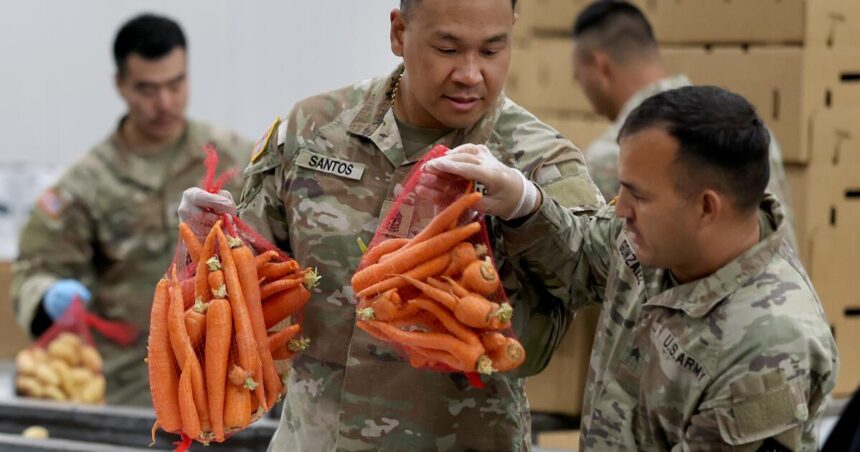
On Friday, the National Guard began a 30-day deployment to Los Angeles Area Food Banks, sorting produce and packing boxes of food. The military will work in a warehouse and will not interact directly with the public because of “increasing concerns” in the community about the military’s role in President Trump’s immigration crackdown, CEO Michael Flood said.
Flood said Los Angeles, already experiencing a surge in demand from laid-off federal workers, expects to see a noticeable increase in demand starting Saturday, leading to increased distribution capacity similar to that seen at the height of the COVID-19 pandemic. This seems strange when you think, “This is a man-made disaster.”
“That doesn’t have to happen,” Flood said. “The people of Washington, D.C., can prevent this from happening.”