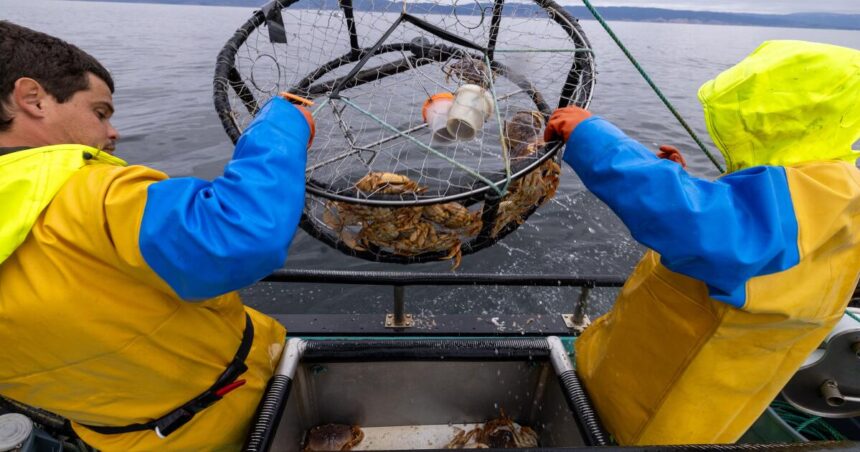
For many Californians, crab bakes, crab cakes, and crab bait are traditional holiday meals.
But the need to protect humpback whales in California’s coastal waters and widespread domoic acid contamination along the north coast are putting the brakes on commercial fishing in Dungeness again this fall.
Ingesting shellfish contaminated with domoic acid can cause illness and death.
The California Department of Fish and Wildlife announced last week that it will run from November 1st to January 1st.
New state regulations require fisheries to be closed if three or more humpback whales are confirmed to be entangled in crab traps during a calendar year. So far in 2025, four whales have become entangled in commercial Dungeness crab fishing lines and lines. Four more humpback whales were caught in crab fishing equipment, which authorities suspected but could not confirm.
Dungeness crabs are typically caught in coastal waters north of San Francisco.
In 2024, California was the leading state in fishing gear entanglement incidents in U.S. waters, accounting for about 25% of the 95 confirmed incidents.
Entanglement is just one of many threats facing whales around the world. Earlier this year, 21 gray whales died in Bay Area waters, most of them from collisions with ships. Animals are being harmed by shipping traffic, noise pollution, waste emissions, disease and plastic debris, reducing their ability to survive and avoid these obstacles.
Jeff Shester, Oceana’s California campaign director and senior scientist, said the postponement “is the best course of action for the fishery and the whales.” “We need to redouble our efforts now, as the risk of more endangered whales becoming entangled in crab traps remains high.”
He said environmentalists and others hope crab fishermen will adapt. New equipment, such as pop-up devices that raise cages to the surface using remote-controlled pop-up balloon devices rather than pulling them with lines, appears to be on track for state approval.
“Delaying the Dungeness crab commercial season by another year is incredibly difficult for our fleet and port communities,” Pacific Coast Fishermen Federation Executive Director Lisa Damrosch said in a joint statement with the Fish and Wildlife Service. “However, given the current risk assessment process, the commercial fleet supported this outcome as the most realistic path forward.”
Recreational crab fishing is scheduled to open in most areas on November 1st. Fishing will be prohibited along the coast from Gualala to Crescent City, where domoic acid is endemic, until state health officials determine domoic acid no longer poses a threat to public health. Health officials south of Gualala, 160 miles to Point Reyes, have issued a crab advisory.
Ryan Bartling, a scientist with the state Department of Fish and Wildlife, said this is the sixth year in a row that fishing has been delayed due to entanglement concerns. In the past, before a numerical threshold was reached, delay was the deciding factor.