The majority of California’s public elementary schools in urban areas are located in paved “natural deserts” that are severely lacking in trees and shade. Most of the state’s 5.8 million school-age children are soaking up the sun during school breaks as rising global temperatures bring more dangerous heat waves.
That’s the conclusion of a team of researchers from the University of California, Los Angeles, the University of California, Davis, and the University of California, Berkeley, who studied changes in tree cover at 7,262 urban public schools across the Golden State from 2018 to 2022.
An ongoing collaborative project developed by research partners the California Department of Forestry and Fire Protection and the U.S. Forest Service found that 85% of schools lost an average of about 1.8% of tree cover over a four-year period.
The team said today’s situation appears to be equally alarming.
The researchers also worked with nonprofit organizations and found in an independent study in 2024 that the median tree cover in California’s K-12 public schoolyards was just 6.4%. And more than half of that canopy exists only as decoration at school entrances, parking lots, and around campus.
“With heat waves becoming a major public health concern in California and across the country, trees can play a huge role in making schools cooler and more resilient to climate change,” said lead researcher Kirsten Schwartz of the University of California, Los Angeles.
The results of the 2018-2022 study, funded by the U.S. Forest Service, were published in the journal Urban Forestry and Urban Planning..
Although 15% of schools surveyed increased tree cover in part due to greening projects, many schools surveyed experienced significant net tree cover decreases during that time, particularly in the Central Valley, greater Sacramento, and Imperial County. In some cases, they added up to more than 40%.
Among the state’s largest school districts, San Francisco had the highest canopy loss at 16.3%. Meanwhile, Sacramento had the biggest increase at 7.5%, followed by Long Beach with a 4% increase.
Los Angeles schools had a small net loss of 0.5%. The researchers cautioned against reading too much into this modest figure. That’s because long-standing disparities in tree cover and shade across the city have meant that schools in poorer neighborhoods farther from the ocean are exposed to more sunlight and intense outdoor heat than schools closer to them, which benefit from cooler sea breezes and lingering ocean clouds.
As part of their ongoing data collection, the researchers conducted new field surveys this summer in select schools (in Southern California, the Bay Area, and parts of the Central Valley). Schwartz said he could not reveal the exact location due to survey agreements with each district.
UCLA researchers created a complete tree inventory for each district’s 16 schools, counting every tree they found on campus, mapping their exact location, identifying the many different species they found, measuring the base and crown of the trees, and assessing the overall health of each tree.
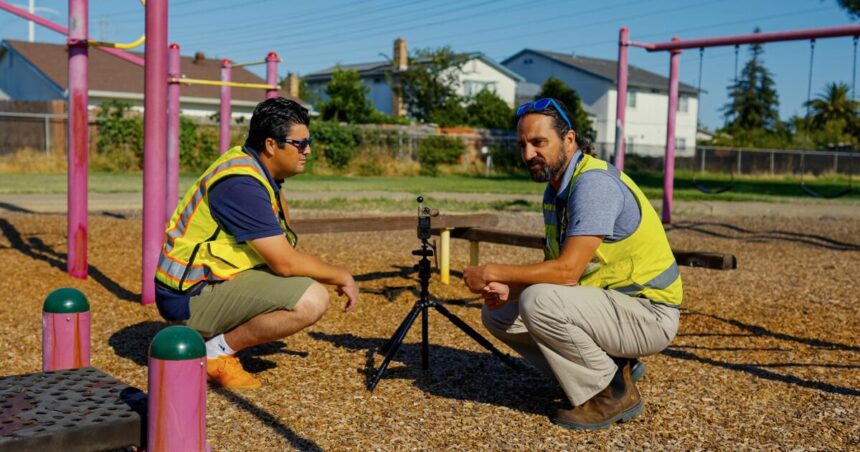
Researchers from the University of California, Davis also accompanied researchers from UCLA to visit some schools in each district and take thermal measurements.
They brought portable weather stations and sensors to each site, as well as samples of various paving materials, including grass, mulch, turf, rubber, and concrete. The researchers took thermal images, recorded temperatures, and measured the humidity around surface materials during times when children were most likely to be outdoors at school. This allowed the team to study the unique microclimates of those campuses over long periods of time.
Alessandro Ossola, an urban plant scientist who leads the team at the University of California, Davis, said it’s important to measure outdoor temperatures on school grounds because children spend a lot of time at school during the school year, and their short stature increases the risk of heat radiating from pavement.
Children also do not have the well-developed ability to regulate their body temperature like adults, making them more vulnerable to extreme heat, which can hinder their ability to learn.
Furthermore, Ossola emphasized that for children who live in areas without grass, safe parks or playgrounds, schools may be the only place they can experience a cool outdoor environment and unpaved surfaces.
“By combining this information, we can look at the entire tree inventory and look at very broad thermal measurements at individual campuses to better understand the cooling effects of those trees,” Schwartz said. “We can also find out what tree species are out there and how well they are adapting to future climate change.”
Schwartz said the team also interviewed local residents at each site to find out who cares for trees at schools, what barriers prevent proper tree care, and what programs are in place to facilitate tree care.
There are many obstacles to making campus more welcoming. Schwartz cited a UCLA team published in 2024 that looked at greening schools with insufficient shade and policies that make it difficult to implement improvements. In some cases, schoolyard greening is hampered by staffing shortages, bureaucratic hurdles, state seismic safety standards that encourage building outward rather than vertically, and funding models that prioritize low-maintenance campuses, the report said.
Schwartz, an urban ecologist, said she was surprised to learn how much regulations requiring surfaces other than grass for sports and outdoor physical education are influencing the design of some schoolyards.
The student report says other schools will have to choose between competing long-term priorities, with future plans to build additional classrooms to accommodate growing student numbers likely to outweigh the desire to create more shaded open space.
Canopy researchers will present each participating school with a tree inventory, an analysis of the findings, policy recommendations, and suggestions for integrating the research into classroom teaching and parent support.
The researchers said their primary motivation for starting the study was to help communities take full advantage of state legislative approvals that schools can apply for to plant grass and trees on campuses to reduce the hazards of heat-radiating surfaces such as asphalt.
“This is a really important part of this conversation about greening schoolyards because removing pavement is an important first step in that,” Schwartz said. “The most important goal is how we can get the most out of our investment in greening our schools.”
Ossola said Californians who want to improve their children’s schoolyards are in some ways playing catch-up, despite community will and financial resources in place. Young trees planted today may take decades to grow enough to provide the cooling effect needed to make children safer on a warming planet.
“This is an important investment that should have been made 20 or 50 years ago,” Ossola said. “I think I’m going to miss the bus right now.”