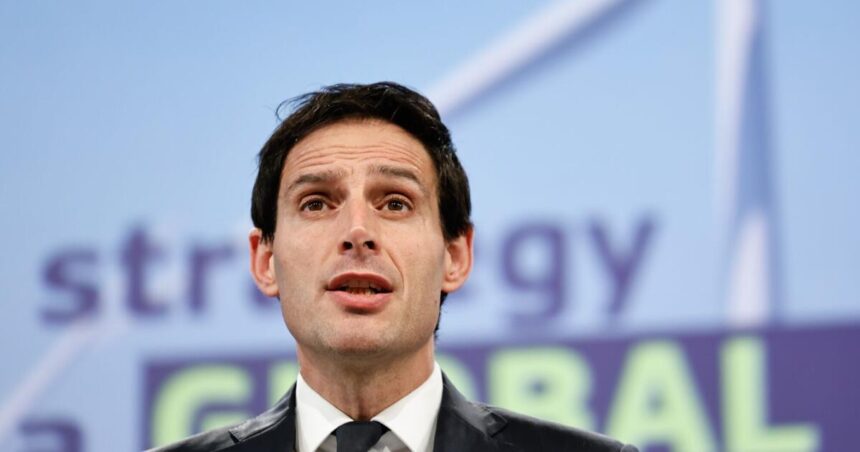
European Union Climate Commissioner Wopke Hoekstra said a U.S. retreat from environmental efforts would hurt the potential global impact and the overall atmosphere of the COP30 conference in Brazil, but it signaled new “partnerships and opportunities” for other countries to build progress.
The United States announced Friday that it would not send senior officials to the U.N.-sponsored event starting this week in the Amazonian city of Belem. In January, President Trump began withdrawing from the Paris Agreement, the global pact to combat climate change, a process that will take a year.
“We’re talking about the largest, most dominant, most important geopolitical player in the entire world. The second-largest emitter,” Hoekstra said of the United States in an interview in Toronto on Saturday. “So when you have a player like that basically say, ‘Okay, I’m going to quit and let the rest of us figure it all out,’ that’s obviously going to be damaging.”
European Commission President Ursula von der Leyen and British Prime Minister Keir Starmer have confirmed their attendance at COP30, and French President Emmanuel Macron and German Chancellor Friedrich Merz are also expected to confirm their attendance in the coming days.
Hoekstra, the EU’s climate chief and a former Dutch minister, described the US’ absence from COP30 as a “watershed moment”, but noted that many US governors and mayors continue to engage on climate issues. He also noted the ongoing business case for decarbonisation.
American companies “may no longer capitalize the C word,” he said, referring to climate. “But what do businesspeople do when there is a business case to continue solar power, batteries and wind power, and the business case is sound? They are trying to reap these benefits, and rightly so.”
COP30 organizers have not disclosed the main goals or agreements for negotiations. The summit, the first of its kind to be held in the Amazon rainforest, will focus on policy implementation and concrete results. Hoekstra said he expects three important outcomes. One is to bridge the gap between current climate policy and what scientists say is needed to limit temperature rise. Actions to expand carbon markets. Each country will then take concrete steps toward climate adaptation.
Most countries have missed deadlines to submit climate change commitments to the United Nations ahead of consultations, and a recent analysis found that these commitments would fall far short of the emissions cuts needed to avoid the worst effects of global warming.
While the EU is a leader in ambitious climate policy with a binding target of net-zero emissions by 2050, it has yet to deliver its own commitments for 2035, namely nationally determined contributions.
“You can easily have a conversation at any time, instead of just leading the conversation yourself,” Hoekstra said. At COP30, the EU “can provide incentives, we can build coalitions and get other countries to join the tent,” he said. But he pointed out that the bloc’s 27 countries together account for only a fraction of the world’s annual emissions.
That means “other countries within the G20 group have no choice but to take action themselves,” Hoekstra said.
China, the world’s biggest greenhouse gas polluter, has submitted an NDC that is considered modest. Hoekstra said China’s climate change policies have “positive and negative sides” and was particularly concerned about the superpower’s push to build coal-fired power plants, which risks locking in future use of fossil fuels. “It’s very important that the world actually refrain from doing that,” he said.
And that NDC is inadequate, he said. “Most experts expected the NDC to be above 30%, or at least around 20%,” he said. “And an NDC of maybe less than 10%? I mean, as much as we want to sum this up in diplomatic terms, it’s hard to see how that is enough.”
China has a carbon market, and Brazil will approach the COP with a proposal for voluntary integration of such a market to accelerate decarbonization. Hoekstra praised carbon markets as an “idea whose time has come,” saying: “It’s not ideological. It’s very impactful.” “And I think at COP30 we can take that even further, not just in terms of its acceptance, but also its scope.”
In the decade since the Paris Agreement, the world has “succeeded in eliminating the most extreme scenarios” of climate change, Hoekstra said, “but only because of the actions we took collectively.” But without stronger countermeasures, significant damage still awaits.
“Climate change is going to be a harsh economic reality,” he said. “If you look at what happened in Slovenia in the summer of 2023, it was flooded and the impact amounted to about 11% of GDP. And every year there are more and more events of this kind, and no one knows who will be affected next year.”
Bochove writes for Bloomberg, along with Bloomberg’s John Ainger, Laura Millan and Ewa Krukowska.