Last week, Bill Gates published on his website what critics say is pitting climate change and public health efforts against each other, when they should be working together.
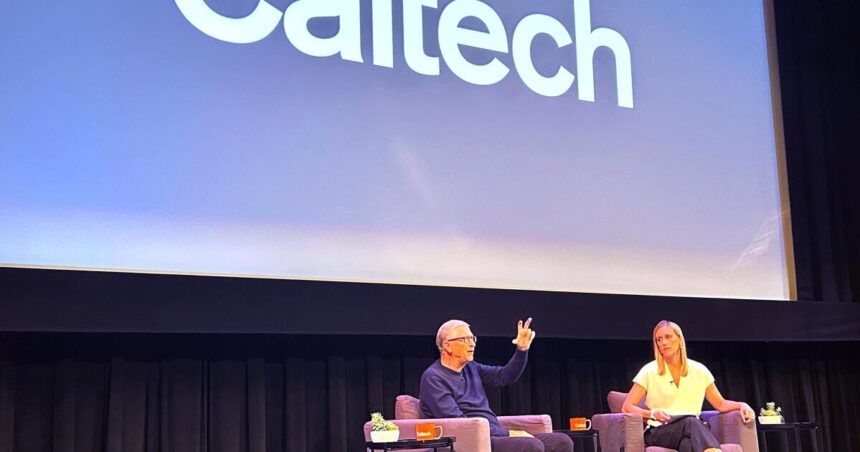
Speaking at the California Institute of Technology in Pasadena on Monday night, Gates dismissed criticism from across the ideological spectrum, including from climate scientists and President Trump.
Gates emphasized that philanthropic resources are limited and said he has shifted some of his efforts from preventing climate change to reducing human disease and malnutrition in what is undoubtedly a warming world.
The journal, published on Tuesday, said that by 2100, global temperatures are likely to rise by 2.0 to 2.4 degrees Celsius compared to pre-industrial levels. Gates said he believes that number will be closer to 3 degrees Celsius.
“The real response is all the things we are doing to help the most vulnerable people on the planet,” he said. He went on to say he wants to refocus scientific innovations that remove climate change-related costs (what he called the “green premium”) from technologies to combat hunger and disease in the world’s poorest countries.
Climate scientists have raised concerns about Gates’ memo, released last week, which they argue inaccurately separates the problems of disease and hunger from climate change. “These are not separate problems, these are exactly the problems that are being exacerbated by this problem,” Katherine Hayhoe, a leading atmospheric scientist who studies climate change, said at a forum with other scientists Tuesday afternoon.
Speaking to an audience of more than 1,000 people, mostly students and professors, at the California Institute of Technology, Gates expressed frustration with climate scientists who criticized his memo for wrongly downplaying the potential effects of climate change.
“What kind of world do they live in?” he asked at one point, arguing that critics fail to consider that spending money to fight disease and other problems can save more lives than investing in reducing carbon emissions.
“In a world with very limited resources, this is a numbers game,” Gates said Monday night. “It’s more finite than necessary.”
Gates also chided Trump for a “serious misreading” of a memo from last Wednesday that suggested Gates no longer believed in climate change.
“I’m a climate change activist, but I’m also a child survival activist, and I hope you are too,” Gates told the audience at the California Institute of Technology. “That is the best way to ensure that everyone has the opportunity to live a healthy life, no matter where they are born or what climate they are born in.”
The billionaire said the shift to focus on human health is aimed at helping poorer countries that typically receive aid from the United States and other rich countries, as the United States withdraws from such large-scale aid. Although the Trump administration’s foreign aid payments in July accounted for only about 1% of national budgets, researchers at the nonprofit Center for Global Development found that the aid saved about 3.3 million lives around the world.
At Caltech, Gates also discussed technologies he supports to mitigate climate change, such as fusion reactors and geoengineering.
Gates’ critics in the climate science community say he is focusing on the wrong things. “It’s like he continually downplays the importance of transitioning to clean energy with the technologies we have in favor of promoting future technologies,” said Michael E. Mann, a climate scientist at the University of Pennsylvania. Mann said some of these technologies could take decades to be implemented at scale. “We don’t have many decades left to address the climate crisis.”