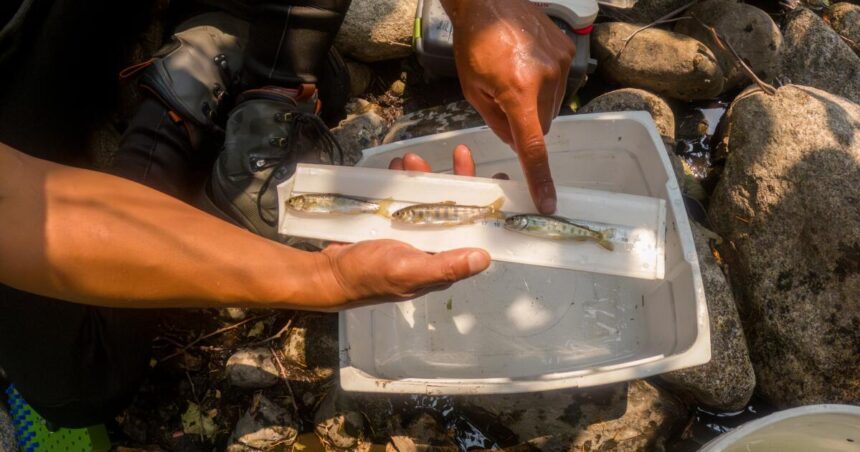
For the first time in more than a century, migrating salmon have come close to the headwaters of the Klamath River’s most remote tributary, 360 miles from the Pacific Ocean in south-central Oregon. The results are the clearest demonstration yet that the world’s largest dam removal project, completed on the river a year ago, will have significant benefits for salmon, river ecosystems, and the tribes and commercial fishermen whose livelihoods revolve around fish.
“I’m very excited,” said Jeff Mitchell, former chairman of the Klamath Tribe and a key participant in the long-running protests and negotiations that led to the dam removal project. “This has been satisfying. Twenty-five years of my life and thousands of miles and thousands of hours of attending meetings and protesting and doing everything we have to do to move this issue forward. Now that’s in the past and I’m watching history unfold before my eyes. It’s amazing to know that these fish are finally home.”
Unfortunately, every positive development in the battleground Klamath watershed seems to have its pitfalls, and this pitfall is ominous. The Trump administration ignored salmon health, slashed funding already earmarked for needed ongoing river restoration, fish monitoring, and fire protection projects, and fired federal employees who helped facilitate them. To make matters worse, in the case of the drought that has plagued the basin for much of this century, the administration has signaled its intention to significantly reduce the amount of river flow needed for salmon, ensuring enough water is allocated to upstream fish farmers. That would leave them vulnerable to diseases like the one that left tens of thousands of dead salmon on the shores of the lower Klamath River in 2002, the largest fish die-off in the history of the American West.
It would probably appear that most of the farmers are Trump supporters. Many members of the tribe do not.
The discovery of salmon in three major tributaries in the Sprague River, including 90 miles upstream, just one year after the dam was completed, far exceeded biologists’ expectations. The achievement builds on another unexpected success a year ago, just weeks after the last of the dam’s material was removed, when it was counted by sonar equipment over 12 days as it swam upstream past four destroyed dam sites.
The arrival of salmon in the upper reaches of the tributaries confirms what is obvious to all but staunch dam proponents who claim that there are no salmon in the upper reaches, despite abundant documentary and scientific evidence of their historical presence in the tributaries. They claim the salmon found there in recent weeks were trucked in by salmon advocates.
When asked about this claim, William Ray, chairman of the Klamath Tribe, whose members live in the area where the salmon arrived, said with a wry smile, “That would be a big truck.”
surely. Jordan Ortega, a fish biologist with the Klamath Tribe, said 150 to 200 Chinook salmon had been observed in tributaries on Upper Klamath Lake as of Tuesday, and that number is increasing daily. An additional 114 people were counted in Upper Klamath Lake. Hundreds of other salmon have been spotted throughout the watershed and even in farmers’ irrigation canals. Their return quickly revitalized the river’s ecosystem, with eagles, otters, and rainbow trout observed feeding on salmon carcasses and eggs.
In order to reach the upper tributaries, the fish overcame numerous obstacles. They dodged harbor seals and sea lions at the river’s mouth, climbed steep rapids, crossed fish ladders at two dams, including one not intended for salmon, swam through two lakes with notoriously poor water quality, and crossed Upper Klamath Lake for 32 miles before finding the mouth of the Williamson River. Once they found a suitable spawning site, they laid and fertilized their eggs. And when Odyssea’s journey was complete, they died, leaving their carcasses behind with nutrients they brought from the sea to feed other animals.
With dam removal paving the way for the recovery of severely diminished salmon stocks, counting salmon stocks is critical for fisheries managers to set sustainable catch limits, evaluate current river restoration projects, and plan new ones. But the Trump administration has slashed regional staff at federal agencies that previously did the counting, cut funding to watershed tribes and threatened the fishing sector.
Even more disturbing is that in May, the Trump administration released a memo saying it does not intend to comply with the provisions of the Endangered Species Act of 1973, which requires providing sufficient water for the Klamath salmon stock to survive.
The government’s interpretation of the law is widely considered questionable, and at least two courts have rejected it in previous cases. But it is unlikely to prevent the government from implementing the plan in future droughts, even if it hurts salmon recovery. The Klamath Tribe, the interim senior water rights holder in the upper basin, could respond by cutting off water supplies to farmers, sending the basin back into the dire water crisis that gripped the basin in 2001.
It will be a classic salmon vs. Trump conflict, pitting resilient animals whose ancestors have survived millions of years of ice ages, volcanic eruptions, tectonic shifts, and droughts against a lawless regime scheduled to disappear in just over three years. Determining the winner will be a powerful indicator of where the basin, the nation and the planet are heading.
Jack Leslie is the author of Deep Water: The Epic Struggle for Dams, Displaced People, and the Environment.