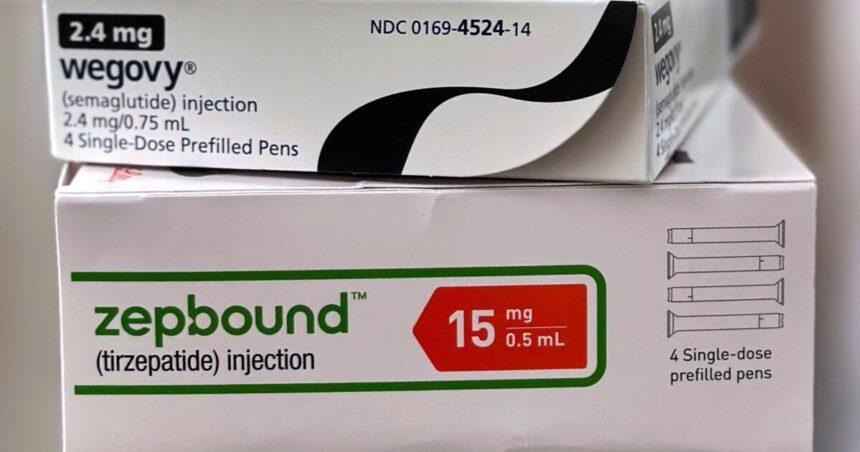
President Donald Trump on Thursday announced a deal with drugmakers Eli Lilly and Novo Nordisk to expand coverage and lower prices for popular obesity drugs Zepbound and Wegoby.
These drugs are part of a new generation of obesity drugs known as GLP-1 receptor agonists, which have surged in popularity in recent years.
But access to the drug has always been an issue for patients, with high doses costing about $500 a month, and insurance coverage has been inadequate.
Starting next year, coverage of obesity drugs will be expanded to include Medicare patients, and some lower prices will be phased in for patients who are not covered, the administration said. The first dose of the tablet version of the new treatment, if approved, will also cost $149 per month.
“(It) will save lives and improve the health of millions of Americans,” President Trump said in an Oval Office announcement, in which he called GLP-1 a “fat pill.”
Thursday’s announcement is the Trump administration’s latest attempt to rein in soaring drug prices to address voters’ concerns about the cost of living. Pharmaceutical companies Pfizer and AstraZeneca recently agreed to lower prescription drug prices for Medicaid after an executive order in May set a deadline for drug companies to selectively lower prices or impose new limits on government payments.
As with other deals, it’s unclear how much of a price reduction consumers will feel. Drug prices can fluctuate due to competition in treatments and insurance coverage.
Obesity drugs are growing in popularity, but they are expensive
Obesity drugs work by targeting hormones in the gut and brain that affect appetite and satiety. In clinical trials, it has been effective in reducing weight by 15% to 22% of body weight, often up to 50 pounds or more.
Patients taking these drugs usually start with small doses and take larger doses as needed. Experts say obesity is considered a chronic disease and must be treated indefinitely or there is a risk that the weight will come back.
The fast-growing treatment has proven especially lucrative for drugmakers Eli Lilly and Co. and Novo Nordisk. Lilly recently said Zepbound’s revenue has tripled to more than $9 billion so far this year.
But for many Americans, the cost has put it out of reach.
Medicare is a federally funded program that primarily covers people over 65, but it does not cover obesity treatment. President Donald Trump’s predecessor, Joe Biden, proposed rules last November that would change that. But the Trump administration repealed it last spring.
Few state and federally funded Medicaid programs provide coverage for low-income individuals. Employers and insurance companies offering commercial insurance are also wary of paying for these drugs, in part because of the large number of patients who may use them.
Doctors say the high-dose treatment costs $500 a month, making it unaffordable for people without insurance.
Medicare currently covers the cost of drugs to treat conditions such as type 2 diabetes and cardiovascular disease, but not just weight loss.
President Trump expresses concerns about cost of living
The effort to lower cost barriers for the popular GLP-1 drug comes as the White House seeks to show that Mr. Trump is responding to Americans’ frustration with rising costs of food, housing, health care and other necessities.
“Mr. Trump is America’s forgotten friend,” Secretary of Health and Human Services Robert F. Kennedy Jr. said in a statement Thursday. “Obesity is a disease of poverty, and overwhelmingly these drugs have only been available to the wealthy.”
President Kennedy has previously expressed skepticism about GLP-1 in combating obesity and related diseases. But he heaped praise on Trump for pushing to make the drug available to a broader group of Americans.
The announcement comes after Republican gubernatorial candidates in New Jersey and Virginia struggled in Tuesday’s elections. Voters’ bleak outlook on the economy appears to be a contributing factor to the election campaign.
About half of Virginia voters say the economy is their top priority, according to an Associated Press voter poll, and about 6 in 10 of them chose Democrat Abigail Spanberger as their gubernatorial candidate, giving her a decisive victory.
In New Jersey, Democrat Mikie Sherrill won about two-thirds of New Jersey voters who said the economy was the biggest issue facing the state, according to a poll. She defeated Republican candidate Jack Ciattarelli, who was endorsed by President Trump. More than half of New York City voters said the cost of living is the biggest issue facing the city. Democratic mayor-elect Zoran Mamdani won about two-thirds of this group.
The White House sought to diminish the previous Democratic administration’s efforts as a gift to the pharmaceutical industry because the proposal did not include adequate price concessions from drug companies.
Administration officials briefing reporters ahead of Trump’s announcement in the Oval Office on Thursday argued that Trump instead entered into a “belt and suspenders” agreement that guarantees Americans will not unfairly fund innovation in the pharmaceutical industry.
Another administration official said drug coverage would be extended to Medicare patients starting next year. The official said Medicare will begin covering the treatment for people who are severely obese or who are overweight or obese and have serious health problems. Those who qualify will pay a $50 co-pay for the drug.
Price reductions will also be phased in for people who are uninsured through the government’s TrumpRx program, which will allow people to buy drugs directly from manufacturers. It starts in January.
Officials said lower prices will also be offered to state and federally funded Medicaid programs. And if approved, the first dose of the new pill version of the obesity drug would cost $149 per month. The average price of drugs sold on TrumpRx starts at about $350 and will drop to $245 over the next two years, government officials said.
Officials briefed reporters on conditions of anonymity based on ground rules set by the White House.
Doctors praise falling prices
Dr. Leslie Golden said about 600 patients have taken one of these treatments, but more than 75% struggle to pay for the treatment. Some people may have to pay a $150 co-pay for refills even if they have insurance.
“Every visit is like, ‘How long can I keep doing this? What am I going to do if I can’t keep doing this?'” said Golden, an obesity medicine specialist in Watertown, Wisconsin. “Some of them are taking extra jobs or delaying retirement to keep paying the bills.”
Both Lilly and Novo have already lowered drug prices. Lilly announced earlier this year that it was lowering the cost for the first dose of Zepbound to $349.
Dr. Angela Fitch, who also treats patients with obesity, said she hopes the agreement between the White House and drug companies is a step toward making treatments more affordable.
“Today, we need heroes in obesity care,” said Fitch, founder and chief medical officer of Knownwell, a weight loss and medical care company. “Communities face unrelenting barriers to accessing GLP-1 therapeutics, and despite the data supporting their effectiveness, it ultimately comes down to affordability.”
Murphy, Madani and Alecia contributed to The Associated Press.