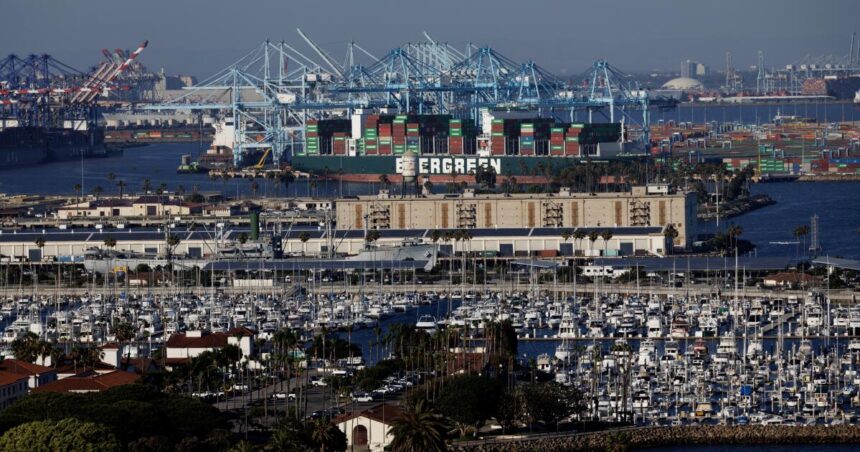
Southern California’s aviation authority voted overwhelmingly Friday to give the ports of Los Angeles and Long Beach the power to impose fines if they don’t follow through on promises to transition to cleaner equipment.
The port remains a source of smog-forming pollution in Southern California, emitting more emissions than the region’s 6 million cars each day.
The South Coast Air Quality Management District board voted 9-1 to require ports to install zero-emission equipment, such as electric truck chargers and hydrogen fuel pumps, to curb air pollution from the heaviest polluters. The plan will be submitted in three stages. Heavy trucks and most cargo transport equipment will be submitted by 2028. small locomotives and port vessels by 2029; Build cargo ships and other large vessels by 2030.
If a port fails to meet the deadline, it will be fined between $50,000 and $200,000, which will be donated to the Clean Air Fund, which supports communities affected by port pollution. AQMD refrained from imposing new rules on ports for five years.
Many environmental activists expressed disappointment in the agreement, saying it did not include specific pollution reduction requirements.
“We urge you not to give up the opportunity to further help address the region’s air pollution crisis in exchange for a small commitment,” said Kathy Ramirez, one of dozens of speakers at Friday’s board meeting. “This is about our lives. I encourage you to think about why you joined the AQMD board. If not for clean air, then what is it for?”
Port officials and members of the shipping industry praised the decision as a pragmatic path to transitioning to a zero-emissions economy.
“The exchange of ideas and compromises in this process accurately reflects what a real-world transition to zero emissions looks like,” said William Bartelson, executive director of the Pacific Maritime Association. “It is practical, comprehensive and based on common goals.”
The vote answers long-standing questions about how AQMD intends to reduce pollution from the sprawling commercial complex, which has been the focus of decades-long environmental justice efforts.
The twin ports of Los Angeles and Long Beach, known as the San Pedro Port Complex, are the largest container ports in the Western Hemisphere, handling 40% of all containerized cargo entering the United States. Despite years of efforts to reduce pollution, the majority of the heavy equipment, big rigs, trains and ships that help transport goods in the region are still powered by diesel engines, which emit harmful particles and nitrogen oxides, a precursor to smog.
For nearly a decade, AQMD has oscillated between strict regulations and more flexible agreements with ports. From 2017 to 2022, several rounds of negotiations on a memorandum of understanding failed. The commission was preparing to require ports to offset smog-forming pollution from trucks, trains and ships through clean air projects such as solar panels and electric vehicle chargers. Instead, the port presented a proposed cooperative agreement to AQMD, prompting AQMD to suspend rulemaking.
In its proposal, AQMD agreed to double the penalties and not create new rules for five years, instead of the 10 years the industry had hoped for.
Perhaps the most important detail of the contract is the type of energy or fuel used. The number of suitable chargers and refueling stations will not be made public for years. The lack of details sparked skepticism from many environmental activists.
“Planning in the hope that emissions reductions will happen in the future is simply a stalling tactic,” said Fernando Gaytan, senior attorney at the environmental nonprofit Earthjustice.
The agreement also includes a provision that allows AQMD or the port to terminate the agreement “for any reason” with 45 days’ written notice. AQMD Executive Director Wayne Nastri said this gives AQMD the option to return to requiring zero-emission infrastructure at ports.
“If we report and there’s no progress, we can take comfort in knowing that we can reverse course and release that (rulemaking) package,” Nastri told the board.
At the end of public comment, those opposed to the agreement erupted into loud chants. AQMD cleared the bleachers while the board discussed the proposal.
Board member Veronica Padilla Campos, the lone “no” vote, said the deal lacked the necessary emissions reductions and lacked “clear accountability” to local communities.
Fellow board member Nitya Raman acknowledged many criticisms of the deal, but ultimately voted in favor.
“I have come to truly believe that the choice before us is to enter into this cooperation agreement or to do nothing on this issue, to continue 10 years of inaction,” Raman said.
“I’m going to vote today to support this bill because I believe this is the only path forward for us to move towards cleaner air in this region, the single largest source of air pollution.”
The plan must be approved by members of the Port of Los Angeles and Port of Long Beach Harbor Commission at a meeting this year.