Democrats’ response this week after several senators caved in to end the government shutdown didn’t quite drown out another noise. It’s the sound of President Trump throwing out ridiculous “policy” ideas as he scrambles to address the unhappiness of his voters, his family, and his donors, evidenced by his promised golden age.
On social media and in interviews, the president (of course) blurts out proposals that are news even to his advisers, who should be the first to scrutinize them. $2,000 rebate for most Americans and Federal debt repayments, all from an assumed tariff windfall. (Don’t count on either reward; more on that later.) New 50-year mortgages to make home buying more affordable (not). Air traffic controllers who did not report to work during the shutdown will be paid without pay, and those who do will receive a $10,000 bonus. (He doesn’t have that power; the government is not his family business.) Most mind-boggling of all, Trump has revived his and the Republican Party’s long-slain promise to “repeal and replace” Obamacare.
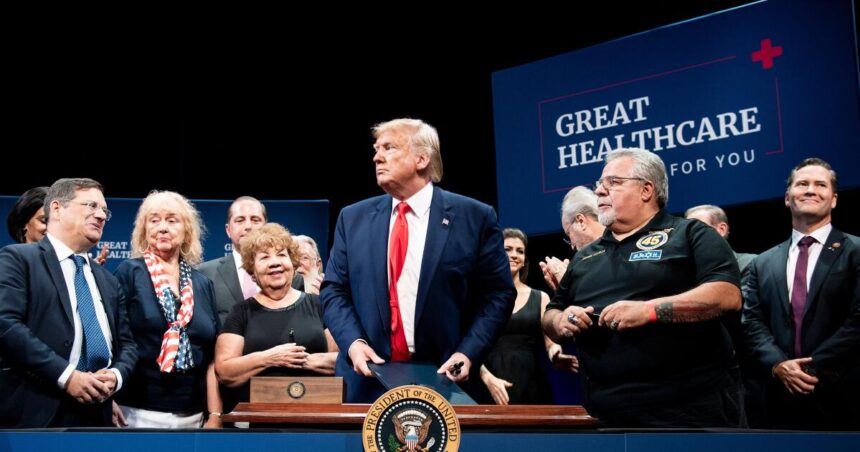
It’s been five years since he promised a health care plan. It’s been a year since he said he promised it during his 2024 campaign. What he’s now calling “Trumpcare” (natch) apparently amounts to paying people to buy insurance. More details will come later, he says.
With such haphazard policy decisions, President Trump only emphasizes the policy ignorance that has been a defining characteristic since he first ran for president. No other president in memory has ever released such ridiculous junk that was so easily belittled and ridiculed.
President Trump did not learn in his first term how to navigate the legislative process, how to bring well-discussed ideas into law. he didn’t want to do that. Additionally, in his second term, Trump eschews that deliberative democratic process in favor of governing by statute law and executive orders (even if the results do not last beyond the president’s term). In Mr. Trump’s case, ideas that are infused with expertise and data don’t catch on. They pop into his head.
But a decision is not always possible, as the government shutdown became a drama after Republicans were unable to agree with Democrats on legislation that must be passed to keep the government funded.
With Republicans controlling the White House and Congress (and likely the Supreme Court, see: siding with the Trump administration on blocking SNAP benefits), Democrats could never really win a shutdown showdown—unless victory meant forcing Republicans to agree to extend the health insurance tax credit for millions of Americans. Expanding health care has never been a priority for Republicans. The tax cuts are mainly for the wealthy and big corporations, and are largely funded by cuts to Medicaid, which Republicans gained with President Trump’s victory a few months ago.
Still, the Democrats won something. It has brought the issue of rising health care costs back to the center stage of politics, linking it to broader issues of affordability in an economy that is not working well for the working class. Drawing attention to the brutal priorities of Trump 2.0 is a big reason why I and many other Democrats pushed for a shutdown, even though policy “W” was unlikely. (I hadn’t yet bought into the Senate Democrats’ argument, which came just after Democrats won a better-than-expected victory in last week’s off-year elections on the strength of their fight for affordability, including health care.)
The battle isn’t over. The Senate is scheduled to debate and vote next month on extending Obamacare tax credits, which would otherwise expire at the end of the year and make coverage impossible. Even if Democrats were to win that vote, which is unlikely, the subsidies would be DOA in the House, a MAGA stronghold. But what’s not over yet is the issue of increasing insurance premiums for all Americans. The situation is dire as we head into the midterm election campaign.
These financial issues have put President Trump on the defensive. The result is his series of politically tone-deaf statements and unexamined, unconventional initiatives.
On Monday night, he invited Fox News host Laura Ingraham to the White House. and Regarding the gold-and-marble renovation, he jokingly responded to her question about Americans’ concerns about the cost of living that comes with this apolitical lifestyle: “More than anything, this is the work of Democratic fraudsters.” To her credit, when Ingraham reminded Trump that he had accused President Biden of saying things were great and things weren’t great, Trump took a shaky stand: “The polls are fake. We have the best economy ever.” (.)
On Saturday, President Trump called on Republicans to “take money from big, crooked insurance companies and give it to the people and end Obamacare.” He told Ingraham, “Call it Trumpcare…anything but Obamacare.” “While these direct payments may allow younger, healthier people to receive cheaper, no-frills coverage, they would leave a disproportionate number of sick people in the insurance pool, resulting in higher costs,” health industry experts blasted.
President Trump spoke early Sunday about his promised $2,000 rebates and $37 trillion reduction in the federal debt, and on Monday he said “trillions” of dollars in tariffs would soon make both possible. On Tuesday night, he sent out a fundraising email: “Would you please accept a customs duty rebate check with your signature?”
Perhaps if he had talked to the Treasury secretary, who professed ignorance about the idea on ABC News’ “This Week” on Sunday, he would have learned that President Trump has raised more than the cost of $2,000 rebates, not trillions, in tariffs over the past year. Not only will you have nothing to put toward your debt, but you will also be paid a kickback. addition Red ink for over 10 years. That would leave Trump just $2 trillion short of the debt he added to the debt during his first term.
When Ingraham asked Trump where the money would come from to pay bonuses to air traffic controllers, Trump quickly replied, “I don’t know. It’s going to come from somewhere.” And when she said the 50-year mortgage proposal “happened” given the potential windfall in interest payments to banks, President Trump was similarly dismissive, saying, “That’s not even a big deal.”
No big deal: That’s Trump-style policymaking.
Blue sky:
thread:
×: