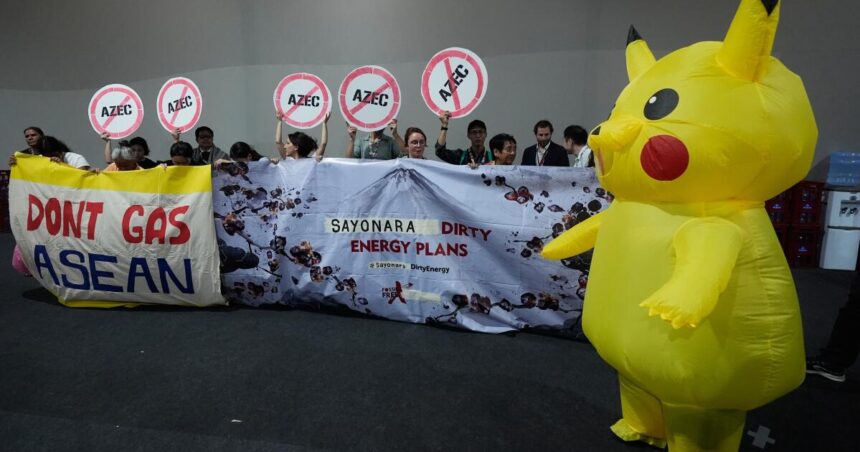
Protesters wearing Pokemon costumes stampeded around the United Nations Climate Change Conference on Friday, sending a message to Japan to stop financing coal and natural gas projects in Southeast Asia and other parts of the Global South.
The Stop Japan Dirty Energy Plan protest coincided with the first of two energy-focused theme days during the annual climate conference known as COP30, which will be held this year in Belem, on the edge of Brazil’s Amazon. Protest organizers said the investment was a major blind spot for Japan, which often touts itself as Asia’s decarbonization leader.
Hiroki Osada of Friends of the Earth Japan, one of the protest organizers, said that by funding energy projects, primarily liquefied natural gas development, in countries such as Thailand, Malaysia, Indonesia and the Philippines, “Japan is actually slowing down the phase-out of fossil fuels across Asia.”
“It is very important that our comrades from the Global South voice their concerns in Belem, so that we can actually demand that the Japanese government take some action on this issue,” he said.
From 2016 to 2024, the government-run Japan Bank for International Cooperation provided $6.4 billion in financing for coal projects and $874 million in financing for gas projects, according to data from the Center for Energy, Ecology and Development, a Philippines-based research and advocacy group, based on government and bank data. The bank, a major conduit for Japan’s overseas aid, did not respond to requests for comment.
The Japanese delegation to COP30 responded to The Associated Press but declined to comment directly on the activists’ claims. Instead, Japanese officials said Japan’s cooperation with Southeast Asian countries to simultaneously achieve “decarbonization, economic growth, and energy security through various channels” was supported by Southeast Asian countries.
A pair of Pikachu bobbing up and down
The protest centered on two people wearing life-size inflatable Pikachu costumes, flanked by several activists.
The event was attended by activists from across the Association of Southeast Asian Nations (ASEAN), which is home to several fossil fuel projects sponsored by Japan. The banner read: “Do not supply gas to ASEAN.” Ian Rivera, National Coordinator of the Philippine Climate Justice Movement, led a chant of “Just Pokemon, no fossil fuels” and “Goodbye fossil fuels.”
Jumping Pikachu then visited pavilions in India, Indonesia and Malaysia to “uncover how Japan is exporting its fossil policies.”
“If countries in the Global North like Japan decide to double their fossil fuel production and exports, it will be impossible for countries in the Global South to make a just energy transition,” said Amiela Sawas, director of research and policy at the Treaty on the Non-Proliferation of Fossil Fuels Initiative.
The Pikachu protests, which have been frequent at recent summits, were sandwiched between other anti-fossil fuel demonstrations and came after Friday morning’s demonstrations blocked the conference’s main entrance and increased security measures for COP30. Earlier, activists hosted a “Kick Out the Suit” event demanding the removal of fossil fuel lobbyists, whom environmentalists accused of undermining negotiations.
On Saturday, when large protests are expected as the midway point of the COP, a huge procession will be held, featuring a “funeral for fossil fuels” in which giant coffins symbolizing coal, oil and gas are carried through the streets of Belém.
Fossil fuels will be high on the agenda at UN climate change talks
Global efforts to transition away from fossil fuels are an important topic on the agenda at COP30. Brazilian President Luiz Inacio Lula da Silva set the tone at last week’s summit by calling on world leaders to develop a roadmap to “overcome dependence on fossil fuels.”
Several countries supported Lula’s call to action, including Denmark, the UK, Kenya, France and Germany.
At COP28 in Dubai, some 200 countries agreed to transition away from fossil fuels, the first commitment in decades of United Nations climate change talks. But many warn that the deal remains seriously flawed.
“COP30 needs actionable outcomes, not another roadmap to nowhere,” said Jasper Inventer, deputy program director at Greenpeace International. “It is positive to see progress being made in Belém, but we must ensure that this actually translates into a clear plan for phasing out fossil fuels and rapidly promoting renewable energy.”
Delgado writes for The Associated Press. This article was produced as part of the 2025 Climate Change Media Partnership, a journalism fellowship hosted by Internews’ Earth Journalism Network and the Stanley Center for Peace and Security.