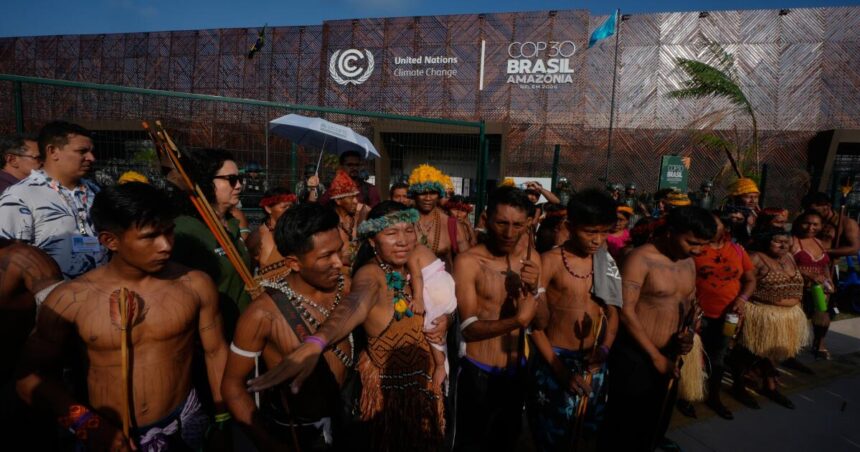
Brazil has set out to host this year’s United Nations climate change talks, pledging to shine a spotlight on indigenous peoples whose livelihoods depend on the Amazon rainforest. Those groups are seizing the opportunity.
On Friday, indigenous protesters blocked entry to the main COP30 venue for the second time this week to demand progress on climate change and other issues. Although their march was peaceful, conference attendees had to detour through a side door and long lines formed to enter the day’s events. One demonstrator likened it to a “scream” against rights violations and decisions made without consulting indigenous peoples.
“I hope the warmth will melt away the coldness in people,” said Chris Julián Pancarar, a member of the Pancarar tribe of Brazil’s Caatinga biome.
Brazilian military personnel prevented demonstrators from entering the scene. The protesters, most wearing traditional indigenous costumes, formed a human chain around the entrance to prevent people from entering. Other activist groups also formed a chain around them.
Paolo Destillo of the environmental group Debt for Climate joined the human chain surrounding the protesters, saying he wanted to give indigenous communities a chance to make their voices heard.
“This is worth delaying the conference,” he said, adding: “If this is truly an indigenous COP, as officials have repeatedly said, this type of demonstration should be welcomed at COP30.”
The two-week conference began on Monday, with countries proposing updated national plans to combat climate change. Scientists say the world is likely to significantly exceed the goal set in the 2015 Paris Agreement to limit global warming to 1.5 degrees Celsius (2.7 degrees Fahrenheit) since pre-industrial times.
What the protesters wanted
Members of the Munduruku indigenous group led the demonstration, demanding a meeting with Brazilian President Luiz Inácio Lula da Silva, and blocked the main entrance.
“President Lula, we are coming before the COP because we want you to listen to us. We refuse to be sacrificed to agribusiness,” the demonstrators said in a written statement in Portuguese released by the Munduruku Ipereg Ayu movement. “Our forests are not for sale. We are the protectors of the climate and we cannot continue to destroy the Amazon to enrich big business.”
Munduruku leaders made a series of demands against Brazil. These include scrapping plans for commercial development of the river, canceling a grain rail project that raised concerns about deforestation, and clarifying the boundaries of indigenous territories. They also want to deny carbon credits from deforestation.
Congress president Andre Correa do Lago, a veteran Brazilian diplomat, met with the group who blocked the entrance. He held a protester’s baby in his arms as he spoke, smiling and nodding. After a long discussion, de Lago and the protesters left together through the entrance. Entrance opened at 9:37am
The United Nations Framework Convention on Climate Change told conference participants there was “no danger” from what it called peaceful demonstrations.
“We’re listening.”
Conference CEO Ana Toni told a press conference that Belém is the most inclusive COP for indigenous peoples, with more than 900 indigenous people registered, far exceeding the previous record of 30.
And she said their voices are being heard.
“We are listening to them,” she said. “The reason we are holding COP on Amazon is to listen to the voices of the most vulnerable.”
Harjeet Singh, a veteran activist against fossil fuels that are causing dangerous warming of the planet, said the protests reflected frustration with past COPs that had “not delivered results”.
“We should see this as a message and a signal from indigenous peoples, who have not seen any progress through the last 33 years of COP, that all these conversations are not leading to action,” Singh said. “They are the custodians of biodiversity and the climate and clearly they are not happy with the way this process is going.”
Separately, indigenous leaders from across the Ecuadorian Amazon used a COP30 side event in Belém to warn that the expansion of oil drilling, mining and agribusiness is pushing the rainforest closer to an irreversible tipping point.
The session, hosted by Amazon Watch and indigenous leaders such as Kichwa, focused on the rollback of environmental and indigenous protections, fossil fuel pollution along the Napo and Amazon rivers, and calls for direct climate finance to indigenous communities.
Speakers also expressed caution about political decisions in Ecuador, including an upcoming referendum, which indigenous groups fear could undermine constitutional “natural rights” and the rights of indigenous groups.
Leonardo Cerda, a Kichwa leader from Napo, said indigenous leaders traveled more than 1,800 miles along the Napo and Amazon rivers to reach COP30.
“It is very important for us that the rights of indigenous peoples are recognized at the COP30 negotiating table, because the decisions taken here often have a direct impact on our territories,” he said. “My journey along the Napo and Amazon rivers showed me how the fossil fuel industry threatens fragile ecosystems like the Amazon and its people.”
Delgado, Borenstein and Walling contributed to The Associated Press. Associated Press writer Stephen Grattan contributed from Bogotá, Colombia.