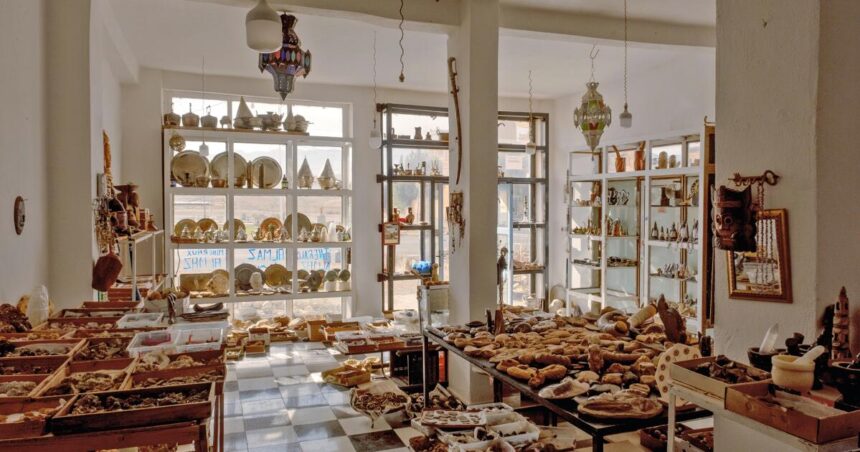
When a fireball from space crashed into the rocky plains of southeastern Morocco in September, Mohamed Benijit loaded up his phone with credit, packed a small magnet and some clothes in his bag, and was ready to set out in search of meteorite fragments.
“We just need to know where it fell,” said the 52-year-old trader in Enzara, a village at the foot of the Atlas Mountains. “In our business, information is everything. Anyone who finds something wants to own it, so it’s not easy.”
Like many other locals, Benigito seeks to profit from the kingdom’s status as a burgeoning base for meteorite hunting.
Morocco has reported more falls than anywhere else in the past 20 years, and about half of all scientific publications related to meteorites are based on discoveries in the country, said Hasna Chennaoui Augehane, a professor of meteorology and planetary sciences at Casablanca’s Hassan II University.
Sales are difficult to track because the global market is fragmented and unregulated, but prices range from a few hundred dollars traded on Internet sites such as eBay to millions of dollars for large chunks sold through auction houses such as Sotheby’s and Christie’s.
The North African country of about 38 million people is boosting tourism in remote areas where traditional pastoralism is being affected by climate change, creating new sources of income while also making it easier for meteor hunters to export their finds.
What was once a “hobby and an important part of local heritage” for thousands of people has become “an extractive activity in its own right,” said Samira Misbhar, an independent social economist specializing in development policy.
Meteorites tend to explode into pieces when they break through the Earth’s outer atmosphere. It may break on impact. Thousands of pieces fall each year, but only a small percentage of the pieces are found, with the majority falling into the ocean or isolated areas.
The rating depends on a variety of factors, including where in the solar system the debris originated and when it fell, as long-term exposure to Earth’s elements can cause contamination and damage.
Most discoveries in the kingdom contain debris that fell years, if not centuries ago.
They come from asteroids, the Moon, and even Mars and contain metals such as cobalt, iron, and nickel that create magnetism. They include so-called carbonaceous chondrites, rich in water, sulfur and carbon-based organic compounds, as well as new species that have “expanded our knowledge of materials in the asteroid belt,” said Guy Consolmagno, an American research astronomer and physicist who heads the Vatican Observatory and the Meteorite Society.
Morocco’s desert climate protects debris, and thanks to its landscape it’s fairly easy to find debris.
Chennawi said these arid regions have been hotspots for decades for a small, clandestine network of experienced meteorite hunters, with the first recorded discovery in 1932.
In 2011, activity increased after several people witnessed a fireball impacting the Hued Draa Valley. Within weeks, the nomads collected the parts and sold them to dealers. London’s Natural History Museum acquired the 2.4-pound lump for £330,000 with the help of an anonymous donor, according to its 2011-12 annual report. Chennawi’s own museum, the Atalik Foundation, has a 7-gram fragment valued at $7,000.
The high selling prices of so-called tiscinto Mars pieces reflect their freshness, rarity, and their Martian origin, confirmed in part by their amalgamated crust and impact glass veins. Less than 0.3% of the debris in the collection was knocked off the surface of the Red Planet, and very little of the debris has been recovered from meteorites that have actually been observed to have fallen.
In 2020, Morocco began experiencing what Chennaoui calls a “gold rush.” At the time, the government made it legal for licensed meteorite hunters to register their finds with the country’s geological bureau and then export or sell up to 90% of their finds, depending on weight, with the remainder to be kept as scientific records.
The license is free, but only available to residents of any nationality. Some licensed hunters organize expeditions for tourists.
Still, Morocco currently has the least restrictive laws of any meteorite-rich country regarding the trade and export of space rocks. Nearby Mauritania does not have its own laws. Algeria, Libya, Egypt and Tunisia have all banned exports.
Lawless Niger launched a formal investigation after what is believed to be the largest piece of Mars on Earth was sold to an anonymous bidder for $5.3 million, including taxes and fees, at a Sotheby’s auction in New York in July. Authorities questioned the export and compared it to illegal trade.
Morocco’s Geology Directorate, which is part of the Ministry of Energy Transition and Sustainable Development, declined to answer questions such as how many people had registered for licenses or how many pieces of debris had been registered. However, numbers alone do not tell the whole story.
“Legal or public circuits can only handle a small portion of transactions,” Chennawi said.
The law builds on the efforts of scientists and cultural heritage advocates who have expressed concern since the 1990s about the huge number of meteorites that have been leaked out of the country without any evidence. And overall, Chennawi said there is a good balance between stakeholders.
She added that she hoped the government would introduce a certification system soon as it could curb underground activities by “maximizing profits”.
The value of meteorites has increased dramatically in the past few decades, said Philip Heck, senior director of the Chicago-based Field Museum. Today, just one gram of lunar meteorite can fetch more than $100, while the same amount of Martian meteorite can cost more than $1,000.
Moroccan buyers include collectors and philanthropists, as well as hundreds of fossil and meteorite shops. Among them is Fawzi Chaabi, owner of Inna Holding, one of the country’s largest family-run conglomerates, who says he is passionate about preserving Morocco’s natural heritage.
“Until a few decades ago, ships carrying meteorites and fossils were sailing from Morocco to North America and Spain without any inspection or regulation,” Chaabi said. “It was painful for me.”
September’s fireball event sparked a massive search by experienced hunters using GPS devices and powerful magnets.
Rashid Adnan, chairman of Midelt’s elected council and one of the group of MPs who pushed for the new law, said about 100 people, some on four-wheelers, were seen rummaging through the desert within a 30-mile radius of Jebel Ayachi.
“This is an exceptional operation,” Adnan said. “It brings in tourists and foreign exchange, and everyone benefits.”
Local residents such as shepherds, merchants and middlemen are also on guard.
Saeed Jaghouzi, a 70-year-old owner of a shop selling meteorites and fossils in the nearby city of Midelt, said people in southeastern Morocco are generally poor and economically driven to hunt for debris and ensure a steady supply.
“We are very poor,” he said. “There’s not much to do except grow apples and watch meteorites.”
The Midelt, Erfoud and Errachidia regions are full of urban legends about meteorite hunters who became wealthy, building their own hotels and investing in date palm cultivation. However, Benigito has not hit the jackpot yet. In the 15 years he has been in the industry, his most valuable find was in 2018, when it fetched about 1,500 dirhams (about $162).
Standing next to a small table covered with trinkets and meteorite fragments at the entrance to Enzara’s weekly market, Benijit said he still didn’t know where to look for the fireball that crashed into Earth in September, but he hoped he could get information from shepherds he has become acquainted with.
“This is beautiful,” he said as he pulled the carefully wrapped 250-gram stone out of his fanny pack, thinking it was worth $1,200. “It came from the moon.”
Karam writes for Bloomberg