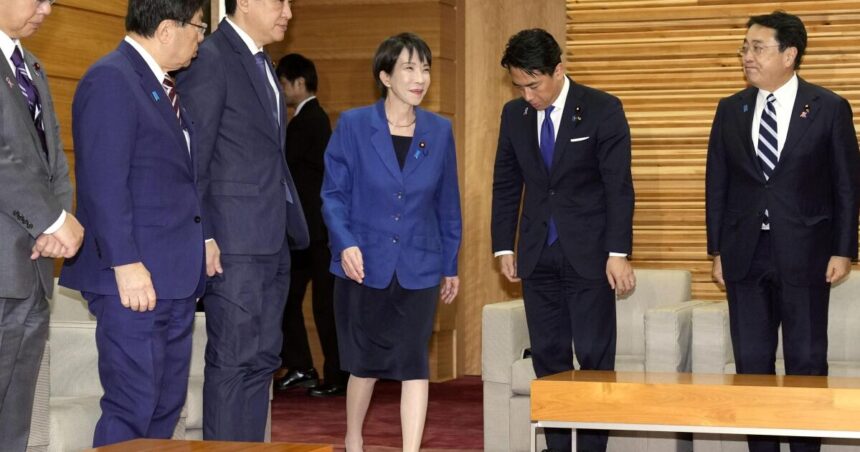
Japan’s Cabinet on Friday approved a 21.3 trillion yen ($135.4 billion) economic stimulus package aimed at stimulating the economy and cushioning the impact of high prices through increased government spending.
After taking office last month, Prime Minister Sanae Takaichi pledged to boost government spending despite concerns that progress in reducing Japan’s national debt, which is about three times the size of the economy, would be delayed.
Takaichi told reporters that the package is aimed at quickly realizing his promises.
“Through wise spending, we will turn fear into hope and achieve a strong economy.”
“What we need to do now is strengthen our national power through expansionary spending through prudent spending and not harm it through policies of excessive retrenchment.”
The spending package is far higher than in years before the coronavirus pandemic and is also aimed at cushioning the impact of increased U.S. tariffs on Japan’s exports to the U.S. under President Trump.
Exports to the United States in October fell for the seventh consecutive month, the government said on Friday, but exports to other countries rose 3.7%, due in part to an increase in exports to Asian countries.
In recent days, investors have sold Japanese government bonds, pushing yields higher while the yen has fallen to near its lowest level this year.
Stocks have also been hit by renewed friction with China after Gaoichi made comments that angered the Chinese government, prompting retaliatory measures such as warnings to Chinese tourists and students not to travel to Japan.
On Friday, the benchmark Nikkei 225 index fell 2.4% on heavy selling, mainly in technology stocks.
The extravagant spending package approved Friday includes subsidies for energy bills, gas tax cuts and other measures to help consumers struggling with rising costs of living. The government reported on Friday that core inflation, which excludes volatile food costs, stood at 3% in October, above the central bank’s target of about 2%.
Specific subsidies include a one-time cash transfer of 20,000 yen (approximately $130) per child, which would require approximately 400 billion yen ($2.6 billion) in government funding and the issuing of coupons such as rice coupons worth 3,000 yen (approximately $20) per child to be distributed by local governments.
The Takaichi administration will need to compile a supplementary budget by the end of this year to cover the funds and receive parliamentary approval. This is a major challenge for her ruling coalition, which lacks a majority in both houses of Congress.
Takaichi succeeded former Prime Minister Shigeru Ishiba, who was effectively ousted by rivals within the ruling party after losing a key election due to voter dissatisfaction with the minority government’s slow response to soaring prices and lagging wages.
As Japan’s first female prime minister, Takaichi has so far enjoyed strong support from the public, with hopes that she can shake up Japan’s elder statesmanship. But she is in a minority government and will need cooperation with opposition parties to pass a supplementary budget and spending package.
Opposition politicians and experts have questioned whether the policy is effective in achieving its objectives, one of which is to lower consumer prices slightly by reducing energy costs. The impact on inflation is expected to be temporary, as increased demand from other stimulus measures tends to push prices higher.
The policy also aims to increase Japan’s gross domestic product by 24 trillion yen ($155 billion), or 1.4% annually, according to the Cabinet Office.
Japan’s economy, the world’s fourth largest, contracted at an annual rate of 1.8% in the July-September period.
Yamaguchi writes for the Associated Press.