Several countries on Friday stood by their insistence that this year’s U.N. climate talks explicitly name the burning of fuels such as oil, gas and coal as a cause of global warming, ensuring that the talks will sprawl beyond a midnight deadline.
Panama’s chief negotiator, Juan Carlos Monterrey Gómez, said the decades-old UN process was at risk of being “turned into a clown show” over inaction. The country was one of 36 countries to oppose the proposal by Andre Correa do Lago, president of the host country Brazil. That’s because the proposal does not provide a clear roadmap for the world’s transition away from fossil fuels, nor does it include strengthening the climate plan submitted earlier this year.
Before the countries entered into high-level negotiations behind closed doors, Monterrey Gómez warned that negotiations were “on the verge of collapse”. A few hours later he said nothing had changed.
Mr. de Lago told diplomats earlier in the day that he thought he was “very close” to the goals he had set out when talks began a week ago. When negotiations between countries stalled, Mr. de Lago decided to convene a smaller negotiating team in his office.
Jennifer Morgan, a veteran observer and former Germany’s chief climate change negotiator, said late Friday afternoon: “I expect we will need another document.” “I think there’s quite a lot of work to be done.”
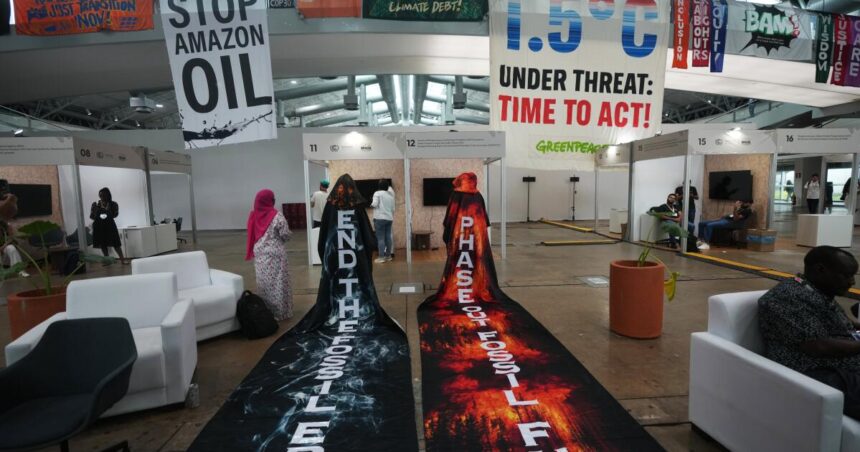
Brazil’s proposal, also known as the document, was released shortly after a fire briefly spread through the pavilion of the conference known as COP30 on the edge of the Amazon River on Thursday. No one was seriously injured, but the fire cost nearly a day’s work.
“The problem is we’re 24 hours behind schedule,” said David Wakow, international climate director at the World Resources Institute.
cold response from many people
The European Union has flatly stated that it does not accept the document. EU Climate Commissioner Wopke Hoekstra reminded negotiators that countries are coming together on the edge of the Amazon to reduce emissions and transition away from fossil fuels.
“Look at the document. There’s nothing in it. There’s no science. There’s no global inventory. There’s no transition. Instead, there’s weakness,” Hoekstra told a closed-door meeting of negotiators, according to people familiar with the matter. “Under no circumstances are we going to accept this. And there’s nothing even close to it. I say this with pain in my heart, but there’s nothing remotely close to what’s on the table right now.”
“Ten years later, this process is still failing,” Environment Minister Maina Vakahua Talia of the small Pacific island nation of Tuvalu said in a speech earlier in the day. “Pacific countries came to COP30 demanding a roadmap to survive and transition away from fossil fuels. But the current draft document released does not even list the main threats to our survival and survival itself.”
The key document from host Brazil’s proposal deals with four difficult issues. These include providing financial aid to vulnerable countries hit hardest by climate change and forcing countries to step up national plans to reduce global warming emissions.
Additionally, there is controversy over the world’s detailed roadmap for phasing out fossil fuels, which are the main cause of the planet’s extreme weather. Such a plan would extend the text of the “transition” away from fossil fuels agreed to during climate talks in Dubai two years ago. However, no timeline or process has been specified, and powerful oil producers such as Saudi Arabia and Russia are opposed.
More than 80 countries have called for stronger direction, and Brazilian President Luiz Inacio Lula da Silva also pushed for it earlier this month.
Former U.S. Vice President Al Gore called on countries to firmly oppose the move and praised Lula’s involvement.
“Saudi Arabia and Donald Trump and Russia under Vladimir Putin have bullied countries into supporting absurd proposals,” Gore said in an interview with The Associated Press. He said the latest document “even removes the proposal to phase out ridiculous and self-defeating subsidies for fossil fuels. This is an OPEC document,” and addressed to the organization representing oil-producing countries.
Fossil fuel initiatives
Regarding the phasing out of fossil fuels, the proposal “recognizes that the global transition to reduced greenhouse gas emissions and climate-resilient development is irreversible and a future trend.”
The document “also acknowledges that the Paris Agreement is working and resolves to go further and move faster,” referring to the 2015 climate change negotiations that set a goal of limiting global warming to 1.5 degrees Celsius (2.7 degrees Fahrenheit) compared with the mid-1800s. A key problem is that the 119 countries submitted emissions reduction plans this year fall short of limiting temperature rise to 1.5 degrees Celsius.
The document does not mention a roadmap for fossil fuel transition, but could end up with a vaguely worded section on plans for the next few years in a separate roadmap.
The 36 countries considered the document to be poorly implemented, including wealthy countries such as the UK, France and Germany, as well as small islands vulnerable to climate change such as Palau, the Marshall Islands and Vanuatu. They said the proposal did not meet the “minimum conditions necessary for a reliable COP outcome”.
Colombia’s Environment Minister Irene Vélez Torres said the president’s proposal was unacceptable to “those of us who are committed to justice for life on Earth and for climate change.”
get everyone in one room
Agreements at these talks are formalized when no country objects, and usually require multiple rounds of negotiation. In practice, an agreement may be adopted, the proceedings are over, and the chairperson may point out an objection and cancel the meeting.
Instead of the usual small group meetings, the Brazilian president’s office convened a meeting of top officials from around the world for much of Friday behind closed doors. It is intended to alleviate countries’ feelings of being left out of behind-the-scenes deals, but it does not allow the public to see their opposing views.
After several hours, the attempt broke down without any sign of success, and de Lago tried a different strategy.
Borenstein, Walling and Delgado contributed to The Associated Press. AP Contributed by journalist Teresa de Miguel Go to this report.