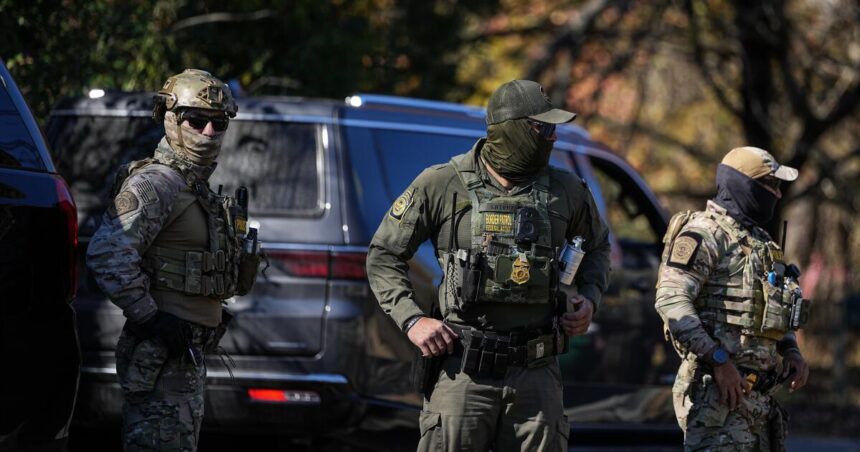
About 250 federal Border Patrol agents will begin a months-long immigration crackdown in southeastern Louisiana and Mississippi on Monday.
The operation, dubbed “Swamp Sweep,” aims to arrest 5,000 people and is centered around liberal New Orleans, the latest federal immigration enforcement operation to target Democratic-run cities as President Trump’s administration pushes ahead with mass deportation policies.
Border Patrol Commander Gregory Bovino, who has led active operations in Chicago, Los Angeles and Charlotte, North Carolina, is expected to lead the operation.
Many people in the greater New Orleans area, especially those in the Latino community, have remained on alert since reports of the planned operation were reported this month. Republican Gov. Jeff Landry said he welcomes federal workers.
Here’s what you need to know:
Border Patrol tactics criticized
Bovino has become the Trump administration’s go-to operative leading a massive and high-profile immigration crackdown campaign. During the operation in Chicago, federal agents rappelled into an apartment complex from a helicopter and fired pepper balls and tear gas at protesters.
In recent months, there has been a surge of migrants in the Chicago area, with federal agents arresting more than 3,200 migrants without disclosing many details. According to federal data, only a few of those arrested had criminal histories that posed a “high public safety risk,” according to court documents for about 600 recent arrests.
The Border Patrol, which typically does not operate in crowded urban areas or with protesters, has been accused of coercive tactics and has filed several lawsuits. A federal judge in Chicago this month accused Bovino of lying and reprimanded him for using chemical irritants against protesters.
Mr. Bovino doubled the agency’s operational efficiency.
“We find and arrest illegal aliens, making our communities safer for the Americans who live there,” he said in a post on X.
Louisiana’s Strict Enforcement Laws
The Justice Department has accused New Orleans of undermining federal immigration enforcement and added it to a list of 18 so-called sanctuary cities. The city’s jail, which has long been under the oversight of a federal judge, does not cooperate with U.S. Immigration and Customs Enforcement under most circumstances, and city police view immigration enforcement as a civil matter outside their jurisdiction.
But the Republican-controlled Louisiana Legislature passed a law forcing government agencies in New Orleans to align with the Trump administration’s hard-line stance on immigration.
One such law makes it a crime to “knowingly” do anything intended to “impede, delay, prevent, or otherwise impede or impede” federal immigration enforcement efforts. Violating the law can result in fines and up to one year in prison.
Lawmakers also expanded the official misconduct charge, which carries up to 10 years in prison for government officials who fail to comply with requests from agencies such as ICE. It also prohibits police and judges from releasing from custody anyone who has “unlawfully entered” or been “unlawfully present” in the United States without first notifying ICE.
new orleans braces
In and around New Orleans, some immigration lawyers say they’ve been flooded with calls from people trying to prepare for upcoming operations. One of the lawyers, Miguel Elias, said his office is doing many consultations online or by phone because people are afraid to come in person.
He likens the steps taken by many in immigrant communities to what people do to prepare for a hurricane: hunker down or evacuate. Families say they are stocking up on groceries to limit how often they leave the house and arranging for friends to take their children to school.
In the days leading up to the Border Patrol’s planned operation, businesses posted signs prohibiting federal agents from entering, and grassroots advocacy groups provided rights-related training and workshops to document the planned crackdown.
Although New Orleans is famous for its eclectic mix of cultures, only 6.7% of the city’s approximately 400,000 people are foreign-born, a percentage that rises to nearly 10% in nearby metropolitan areas. This is still well below the national average of 14.3%, according to U.S. Census data.
According to , the Latino population surged during post-Hurricane Katrina recovery efforts in 2005 and now makes up about 14% of the city.
It is estimated that as of 2023, Louisiana will be home to 110,000 immigrants without permanent legal status, representing approximately 2.4% of the state’s population. Most of them are from Honduras.
Amanda Toups, who owns the New Orleans Cajun restaurant Toups Meatly and runs a nonprofit that helps feed neighbors in need, said she expects the federal action will hurt the city’s tourism-dependent economy, which supports the rest of Louisiana.
“If you’re reducing even 5% of tourism, that’s devastating,” she says. “You’re brown and you’re walking somewhere in town and you might get tackled by ICE. And you’re an American citizen? So you want to travel to New Orleans?”
Mr. Brook, Mr. Santana and Mr. Klein are contributors to The Associated Press, reporting from New Orleans, Washington, and Baton Rouge, Louisiana, respectively.