Seeking cheap and quick strategies to prevent deadly wildfires, U.S. and European power companies are contracting with a handful of artificial intelligence startups to map wildfire risk along thousands of miles of power lines and choose individual trees to cut down and utility poles to replace.
The most obvious way to prevent fires from starting in electrical equipment is to bury power lines underground. But at a cost of more than $3 million per mile, many investor-owned utilities limit underground lines to a few hundred miles per year. This is proving to be a huge opportunity for several technology companies that use machine learning to provide custom recommendations for targeted and relatively low-cost fixes, including those that can be paid for from your maintenance budget.
Massachusetts-based Overstory analyzes high-definition satellite imagery to identify trees that are most likely to fall or have their branches fall onto power lines, and therefore the trees that most need to be removed. CEO Fiona Spruill said the company started by developing tools to detect and stop deforestation. “We can have a big impact from a climate perspective in terms of being able to help prevent wildfires,” she said. The company recently closed an oversubscribed Series B funding round, raising over $43 million.
Mr. Spruill said Overstory’s customers currently include American Electric Power Co.’s Texas utility, California’s Pacific Gas & Electric Co., as well as major U.S. power companies. Meanwhile, UK-based National Grid has signed an agreement with San Francisco-based climate technology company Rhizome for custom modeling to recommend investments in fire protection.
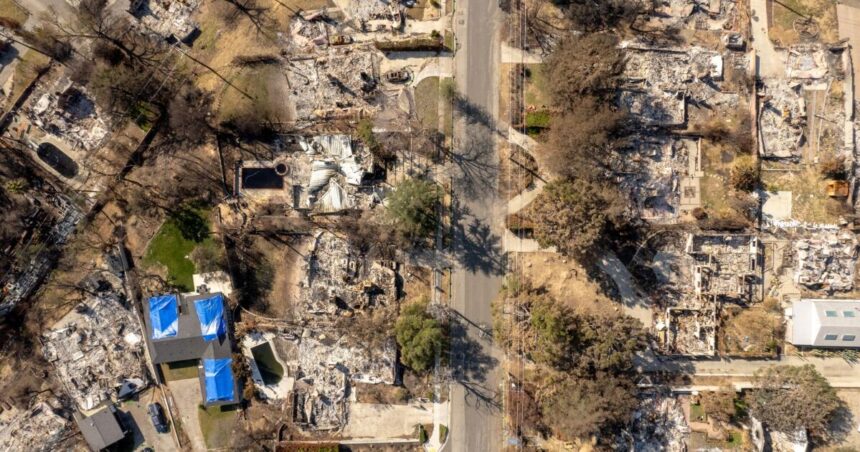
The stakes for power companies are high. Edison International’s Southern California power company is facing a lawsuit over possible links to the Eaton Fire in Altadena, which killed 19 people in January. PG&E was forced to declare bankruptcy in 2019 due to liability from deadly wildfires in Northern California.
Since then, PG&E has worked with Overstory staff to map the precise location and health status of individual trees throughout California’s vast service area, which spans more than 500 miles. The premise is that it’s cheaper and more comprehensive than sending public works crews to inspect trees from the ground or helicopters to spot problem spots from the air.
To train the AI, Overstory relied on a large team of arborists, who contributed on-the-ground measurements and observations of diseased and dying trees. Your company’s data and risk predictions are loaded into a custom web platform that makes recommendations on what to trim and how often.
Mishal Thadani, co-founder and CEO of Rhizome, said his company aimed to help utilities decide which fire risk interventions, from cutting down trees to replacing flammable wood poles to installing new safety equipment, would provide the greatest bang for the buck. Rhizome’s GridFIRM model analyzes a range of site-specific information about a given grid, such as local weather trends and maintenance records, and can take into account information about nearby real estate and population affected by a fire.
National Grid will soon begin using this model in the UK, and has already adopted it on its grids in New York and Massachusetts. While these states may not traditionally be considered fire-prone states, the amount of land burned within their state borders more than tripled from 2023 to 2024, according to data from the U.S. National Interagency Coordination Center, the federal government’s hub for tracking and managing wildfire responses.
Rhizome’s technology is already overturning some of the utilities’ assumptions about fire risk, said Casey Kirkpatrick, director of group strategic engineering at National Grid. National Grid had previously assumed the situation would be worse in areas near large cities, where fires often start, and in parts of the grid near dense forests. But some of the biggest risks lurk in the suburbs.
Human-induced climate change is causing more unstable and extreme weather events. Heavy winter rains cause grasses and brush to flourish, followed by summer heat domes and rapid droughts that kill plants and weaken trees. Researchers found that drought stress can also lead to disease growth in forested areas.
“Climate change is causing trees to die in new and different ways,” Overstory’s Spruill said, meaning “maintenance programs that may have worked 10 years ago may no longer work.”
Regular removal of trees near power lines is a central part of utility maintenance programs. Some companies are experimenting with more aggressive disconnections, but this may not be the most cost-effective way to control system-wide fire risk, said Duncan Carraway, a power systems researcher who heads the Energy and Resources Group at the University of California, Berkeley.
Callaway was part of a team that recently investigated PG&E’s fire mitigation program. The team’s analysis, published in the journal Nature Climate Change, found that fast-trip safety settings, which immediately cut off power when equipment begins to fail, provided the greatest cost-effective benefits and prevented about 80% of potential fire outbreaks. More targeted trimming of known problem areas may reduce the remaining risk of causing fires, but cannot completely eliminate them, Calloway said.
“Unless you spend an extraordinary amount of money” to bury all the power lines, “there’s always a risk of a fire,” Calloway said. “If that cost is making it difficult for people to pay their bills, which is certainly something that’s already on the mind, at some point you have to live with the discomfort of residual risk.”
However, utilities can face devastating financial impacts from wildfire-related lawsuits, fines, and insurance premiums, increasing demand for tools that can reduce residual risk. Overstory recently released a model that helped identify the presence of dry grass and brush at the base of high-power power lines associated with two devastating fires caused by PG&E in 2018 and 2019.
Andy Abranches, PG&E’s vice president of wildfire mitigation, said the Kincade Fire and the deadly Camp Fire, which forced the company into bankruptcy, “basically happened on power transmission towers.” Both could have been prevented by clearing away the dry, flammable brush under the tower. “Even if the device had failed, the sparks would have fallen to the ground,” he says. “There would have been no fire.”
Rosenthal and Wirtz write for Bloomberg.