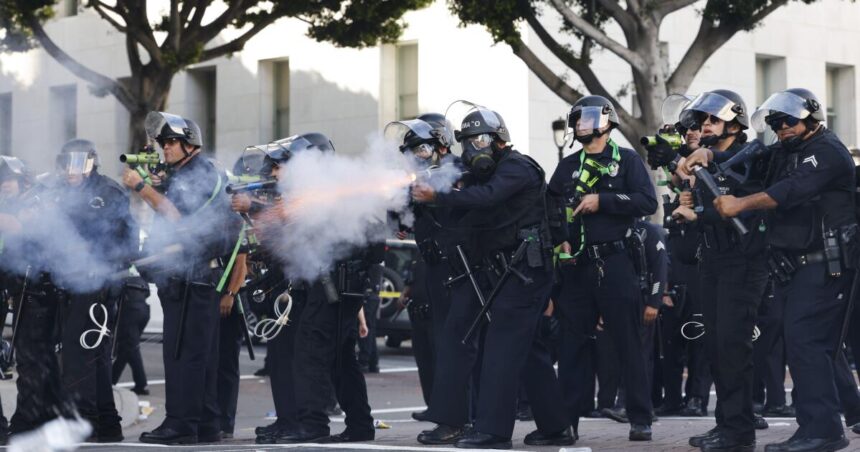
The Los Angeles City Council on Tuesday voted against a proposal to ban police from using hard foam bullets and tear gas weapons amid lingering concerns about their use in protests last summer.
After hearing arguments from both sides, the House of Representatives voted 8-4 to not approve the bill, with three members absent.
Ordinance supporter Hugo Soto Martínez, addressing colleagues Tuesday, said he felt additional restrictions were warranted because Los Angeles Police Department officers appear to be deploying their weapons in ways that violate state law, court orders and the department’s own policies.
He said videos from protests against the federal immigration crackdown that roiled the city last summer “reveal proven evidence of military equipment being used in a way that gives everyone in this group pause.”
He noted that on one day in early June, LAPD officers fired more than 1,000 rounds of foam bullets, appearing to fire indiscriminately into crowds of protesters, using weapons meant to target specific individuals.
“Residents should be able to express their rights without being met with rubber bullets or tear gas,” he said.
Los Angeles Police Department policy is set by the Police Commission, a five-member private organization. Other than approving the city’s annual budget, the City Council has limited oversight of the Los Angeles Police Department.
But City Council members sign off on the department’s annual report on the acquisition and use of anything considered military equipment under state law. The use of such items, including high-powered rifles, drones, explosives and long-range acoustic devices, has come under increasing scrutiny in recent years, with critics claiming that enforcement has become more aggressive on the streets of many U.S. cities.
The failed proposal would have prohibited the Los Angeles Police Department from using two types of military weapons: tear gas and so-called less-lethal 40mm projectiles, not just at protests but also on routine patrols and other special events.
City Councilman John Lee said he was concerned that taking away such weapons would lead to more use of deadly force.
“It’s amazing that we would even entertain this,” Los Angeles Police Department Chief Jim McDonnell said, noting that the 40mm launcher is meant to de-escalate encounters with uncooperative and violent suspects.
He offered to show councilors video of the chaos in which officers used their weapons. He also noted that the department cracks down on hundreds of protests each year that do not involve officers firing less-lethal projectiles. The device fires a projectile, roughly the size of a mini-soda can, at speeds of more than 200 miles per hour.
“Taking those tools away from us puts us in a very bad position,” McDonnell said. He said tear gas was only allowed to be used at large demonstrations in June after “violent” protesters erected barriers and began firing “industrial” fireworks at police.
“This is really a de-escalation tool,” McDonnell said. “To me, going down this path is incredibly ignorant public policy.”
The meeting became tense at times, particularly when Councilman Eunice Hernandez pressed McDonnell about the department’s response to the protests.
Mr. McDonnell interrupted multiple times to say that hard foam projectiles allow police officers to avoid using more dangerous weapons, and urged Mr. Hernandez to receive in-person education about the weapon before voting.
“I would say this is a crowd control tool, not a de-escalation tool,” Hernandez said. He also took exception to McDonnell’s call of the Los Angeles Police Department as a “model” for other departments, pointing to the large legal outlays the city has had to shell out over excessive force and other misconduct by police.
“You’re trying to put a price on saving lives,” McDonnell retorted.
Police’s use of force to suppress, rather than kill, has also been challenged in court. In September, a federal judge prohibited Homeland Security and Los Angeles Police Department officers from using less-than-lethal force against peaceful protesters and journalists.
Critics argue that the term “less-lethal” is misleading because the use of such weapons has resulted in deaths and large legal damages for people who sued after being shot in the head or groin.