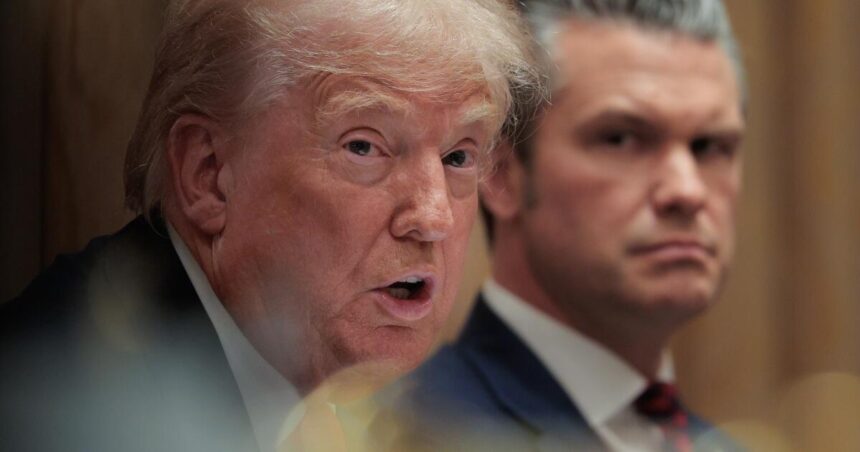
President Trump announced Wednesday that the United States had seized an oil tanker off the coast of Venezuela, amid heightened tensions with President Nicolas Maduro’s government.
The use of U.S. troops to seize an oil tanker is highly unusual and marks the latest effort by the Trump administration to increase pressure on President Maduro, who has been indicted on drug-terrorism charges in the United States. The United States has built its largest military presence in the region in decades, launching a series of deadly attacks on suspected drug-smuggling vessels in the Caribbean and eastern Pacific Ocean. The campaign faces increased scrutiny from Congress.
“We just seized a tanker off the coast of Venezuela. It’s a large tanker, a very large tanker, the largest tanker that’s ever been seized,” Trump told reporters at the White House, later adding, “It was seized for a very good reason.”
Trump said there were “other things going on” but said he would talk more about that later, without providing additional details. Asked what would happen to the oil in the tanker, Trump said: “Well, I think we’re keeping it.”
The seizure was led by the U.S. Coast Guard and assisted by the Navy, said a U.S. official who was not authorized to comment publicly and spoke on condition of anonymity. The official added that the seizure was carried out under US law enforcement authorities.
Venezuela has the world’s largest proven oil reserves, producing approximately 1 million barrels per day. Locked out of the global oil market by U.S. sanctions, the state-owned oil company sells most of its production to Chinese refineries at deep discounts.
Trades typically involve a complex network of shadowy intermediaries, as existing traders are shunned by sanctions. Many are shell companies, registered in jurisdictions known for their secrecy. Buyers deploy so-called ghost tankers that hide their location and deliver valuable cargo in the middle of the ocean before reaching their final destination.
President Maduro did not mention the seizure in a speech before a demonstration organized by his ruling party in the Venezuelan capital, Caracas. But he told supporters that the country was “ready to break the teeth of the North American empire if necessary.”
Surrounded by senior officials, President Maduro said that only the ruling party “can guarantee peace, stability and harmonious development in Venezuela, South America and the Caribbean.”
President Maduro has previously insisted that the real purpose of the U.S. military operation was to oust him from office.
Concessions the United States made to Mr. Maduro in past negotiations included allowing oil giant Chevron to resume pumping and exporting Venezuelan crude. The company’s operations in the South American country have become a financial lifeline for Maduro’s government.
The seizure came a day after the U.S. military flew a pair of fighter jets over the Gulf of Venezuela in what appears to be the closest the jets have come to the South American nation’s airspace. President Trump said a ground attack would be carried out soon, but gave no further details.
The Trump administration is facing intense scrutiny from lawmakers over its boat strike campaign. The campaign has killed at least 87 people in 22 known strikes since early September, including an additional strike that killed two survivors clinging to boat wreckage from the initial attack.
Some legal experts and Democrats say the move may have violated laws governing the use of deadly force.
Lawmakers have requested access to the unedited footage of the airstrike, but Defense Secretary Pete Hegseth told Congressional leaders Tuesday that he is still considering whether to release it. Hegseth, along with Secretary of State Marco Rubio and CIA Director John Ratcliffe, gave classified briefings to Congressional leaders.
It was not immediately clear on Wednesday who owned the tanker or which flag it was flying under. The Coast Guard referred a request for comment to the White House.
Madani and Tropin contributed to The Associated Press. Associated Press writer Regina Garcia Cano in Caracas, Venezuela, contributed to this report.