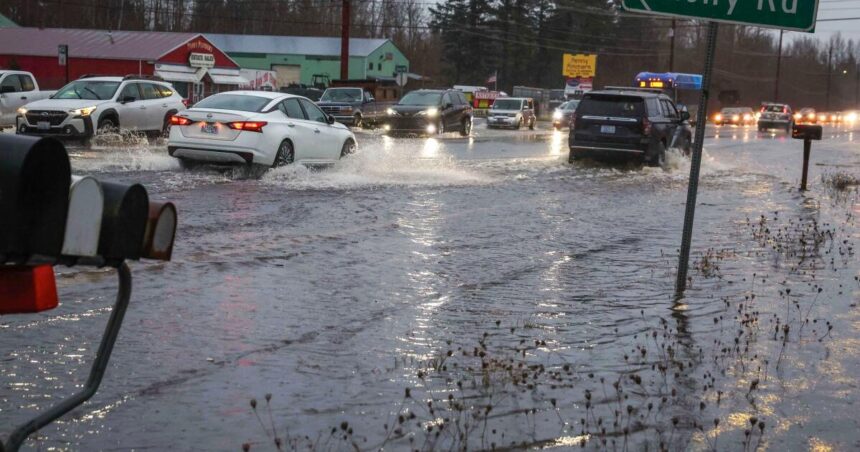
Washington state was under a state of emergency on Thursday as torrential rains caused rivers to overflow their banks, landslides collapsed highways and people were trapped in floodwaters. Tens of thousands of residents could face evacuation orders.
Heavy rain continued to fall in parts of the state Thursday morning, causing road closures, water rescues and the cancellation of Amtrak trains between Seattle and Vancouver. Rainfall increased in some counties in Washington’s Cascade Mountains, with up to 6 inches of rain falling in 24 hours. One of those areas, Snoqualmie Pass, received an additional 1.7 inches of rain in six hours, according to the National Weather Service.
After days of unrelenting rain, Gov. Bob Ferguson declared a state of emergency across the state by Wednesday night, warning that “lives will be at risk in the coming days.” Some residents have already been told to evacuate to higher ground, and Skagit County, a major agricultural region north of Seattle, has ordered residents within the Skagit River floodplain to evacuate.
Ferguson said Wednesday night on social media platform
Washington National Guard Adjutant General Gent Welsh said hundreds of National Guard troops will be deployed to support local communities.
Pierce County sheriff’s deputies rescued people Wednesday at an RV park in Orting, helping one man wearing a Santa hat wade through waist-deep water in a ravine that runs to the base of Mount Rainier southeast of Seattle. Evacuation orders have been issued for parts of town due to concerns that water levels in the Puyallup River are so high that levees are rising upstream.
A landslide has closed part of Interstate 90 east of Seattle, and photos from Eastside Fire & Rescue show vehicles stuck in tree trunks, branches, mud and standing water. Officials also closed a mountain section of U.S. 2 due to rocks, trees and mud.
More than 17,000 customers were without power in Washington on Thursday, according to PowerOutage.us.
River flooding could break records
Skagit River water levels are expected to crest at about 47 feet in the mountain town of Concrete early Thursday and 41 feet in Mount Vernon early Friday.
“We’re very confident that we can handle ‘normal flooding,’ but no one really knows what a 41-, 42-foot river south of Mount Vernon looks like,” Skagit County Levee District 3 Commissioner Darin Morrison said during a public meeting Wednesday night.
The county closed non-essential government services Thursday, including all district court and superior court services.
Mount Vernon, the county’s largest city with about 35,000 residents, has long suffered from flooding from the river. Floods in 2003 displaced hundreds of people.
The city completed a seawall in 2018 that helps protect downtown. It passed a major test in 2021 when river levels reached near record levels.
But the city is on high alert. Historic river levels expected on Friday could top the wall, leading some to fear old levees could burst.
“It could be catastrophic,” said Ellen Gamson, executive director of the Mount Vernon Downtown Association.
Jake Lumbly added sandbags, tested water pumps and moved valuables to the top floor of the home he shares with his 19-year-old son.
“This is my only possession,” he said Wednesday from his front door. “There’s nothing else.”
Cities respond to flooding
Harrison Rademacher, a meteorologist with the National Weather Service in Seattle, described the atmospheric river soaking the region as a “jet stream of moisture” across the Pacific Ocean with “nozzles pushing right along the coasts of Oregon and Washington.”
In Sumas, a small city on the U.S.-Canada border, flood sirens blared at City Hall and residents were ordered to leave. The border crossing was also closed to southbound commercial vehicles to allow room for evacuations, according to the Abbotsford Police Department.
Climate change is thought to be linked to some of the heavier rainfall. Scientists say that without specific research they cannot directly link any single weather event to climate change, but that it generally causes more intense and frequent extreme storms, droughts, floods and wildfires.
Another storm system is expected to bring more rain starting Sunday.
“The pattern is likely to be quite volatile heading into the holiday season,” Rademacher said.
Attanasio and Rush contributed to The Associated Press. Rush reported from Portland, Oregon, from AP reporters Gene Johnson and Harry Golden in Seattle. Martha Belair of Issaquah, Washington; Sarah Brumfield of Cockeysville, Maryland; and Kathy McCormack in Concord, New Hampshire, contributed to this report.