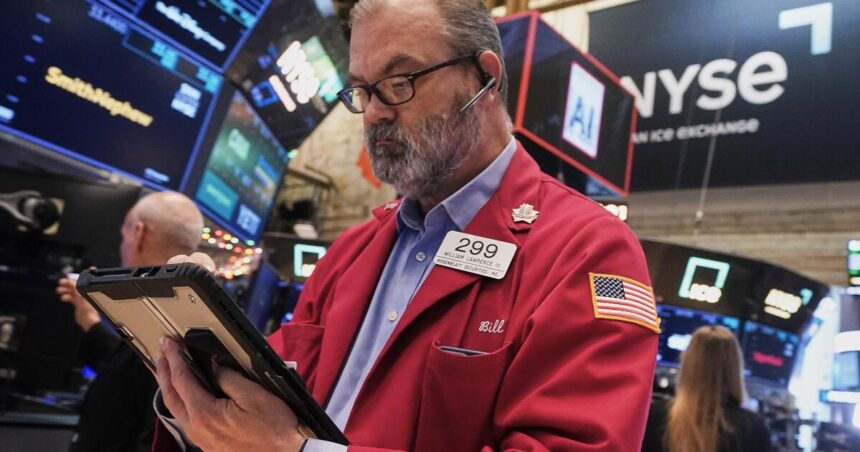
Wall Street set records Thursday even as a drop in Oracle stock and concerns about a possible artificial intelligence technology bubble weighed on the market.
The S&P 500 rose 0.2%, surpassing its all-time closing high set in October. The Dow Jones Industrial Average rose 646 points, or 1.3%, topping its own record set last month. The Nasdaq Composite lagged, falling 0.3% due to weakness in AI stocks.
This is the latest time the market has recovered to record after a series of debilitating concerns. Recent concerns include what the Federal Reserve will do with interest rates and whether every dollar flowing into AI chips and data centers will generate as much profit and productivity as proponents hope.
Those concerns led Wall Street to regain its footing last month, with some boosts after the worst and scariest day since the April crash. Chief among them was the continuing parade of companies that claim they’re making bigger profits than analysts expected. Stock prices tend to correlate with corporate profits over the long term.
The Fed also cut its key interest rate for the third time this year on Wednesday, signaling further rate cuts could come in 2026. Wall Street likes lower interest rates because they can stimulate the economy and drive up investment prices, even if it may worsen inflation.
Fed Chairman Jerome Powell has indicated that interest rates may remain unchanged for some time. But his comments appeared to be less harsh than some investors had expected, in terms of blocking the possibility of further rate cuts in 2026, which helped calm his nerves.
Lower interest rates could benefit small businesses the most, which are more likely to be in the red and often need to borrow money to grow. The Russell 2000 index of America’s smallest stocks led the market, rising 1.2%.
Banks and other companies whose profits are closely tied to the strength of the economy also rose. Goldman Sachs’ 2.5% rise and Visa’s 6.1% rise were the strongest forces pushing the Dow higher.
The Walt Disney Co. rose 2.4% after OpenAI announced the entertainment giant is investing $1 billion in the company. This is part of a three-year agreement that will also allow OpenAI to generate short, user-directed social videos using more than 200 Disney, Marvel, Pixar, and Star Wars characters.
Eli Lilly rose 1.6% after announcing encouraging results from a clinical trial in obese or overweight adults without diabetes with knee osteoarthritis. Planet Labs PBC, which provides satellite imagery used by governments and businesses, soared 35% after the company reported better-than-analyst expectations for its latest quarter.
But just because the U.S. stock market is back to record levels doesn’t mean all concerns are gone.
Oracle fell 10.8%, briefly posting its worst loss earlier in the day since 2001, when the dot-com bubble was still deflating.
Questions remain as to whether all the money Oracle is spending on AI technology is worth it. Analysts said they were surprised by Oracle’s announcement late Wednesday of how much it will spend on investments this year, and questions remain about how the company will pay for it.
These doubts weigh widely on the AI industry, even as billions of dollars continue to flow in.
Nvidia, the semiconductor company that has become the poster child for the AI boom and generates nearly $20 billion a month, fell 1.5% on Thursday. Its huge size makes it the heaviest weight in the S&P 500.
Oxford Industries was also a Wall Street loser. The company, which owns Tommy Bahama and Lilly Pulitzer, fell 21.2% after highlighting how its customers are looking for deals and are “very value-conscious.”
Chief Executive Tom Chubb lowered his full-year sales forecast, saying the holiday season had gotten off to a weaker start than the company expected.
Low- and middle-income households are feeling the pressure of high prices after years of high inflation and a slowing job market. That means there’s about a 25% chance of a recession, said Barry Bannister, chief equity strategist at Stifel.
He said that even with all the ongoing spending on AI chips, it “will not be enough to offset the consumer backlash” and that the U.S. stock market generally still looks expensive relative to history.
Overall, the S&P 500 rose 14.32 points to 6,901.00. The Dow Jones Industrial Average rose $646.26 to $48,704.01, and the Nasdaq Composite Index fell $60.30 to $23,593.86.
In the bond market, Treasury yields were relatively stable following reports that the number of U.S. workers applying for unemployment benefits surged last week, faster than economists expected. This could indicate an increase in layoffs.
The yield on the 10-year U.S. Treasury rose slightly to 4.14% from 4.13% late Wednesday.
In overseas stock markets, indexes rose in Europe after falling in most of Asia.
Japan’s Nikkei Stock Average fell 0.9%, hurt by a steep decline in SoftBank Group, a major AI investor.
Cho writes for The Associated Press.